
BUSINESS
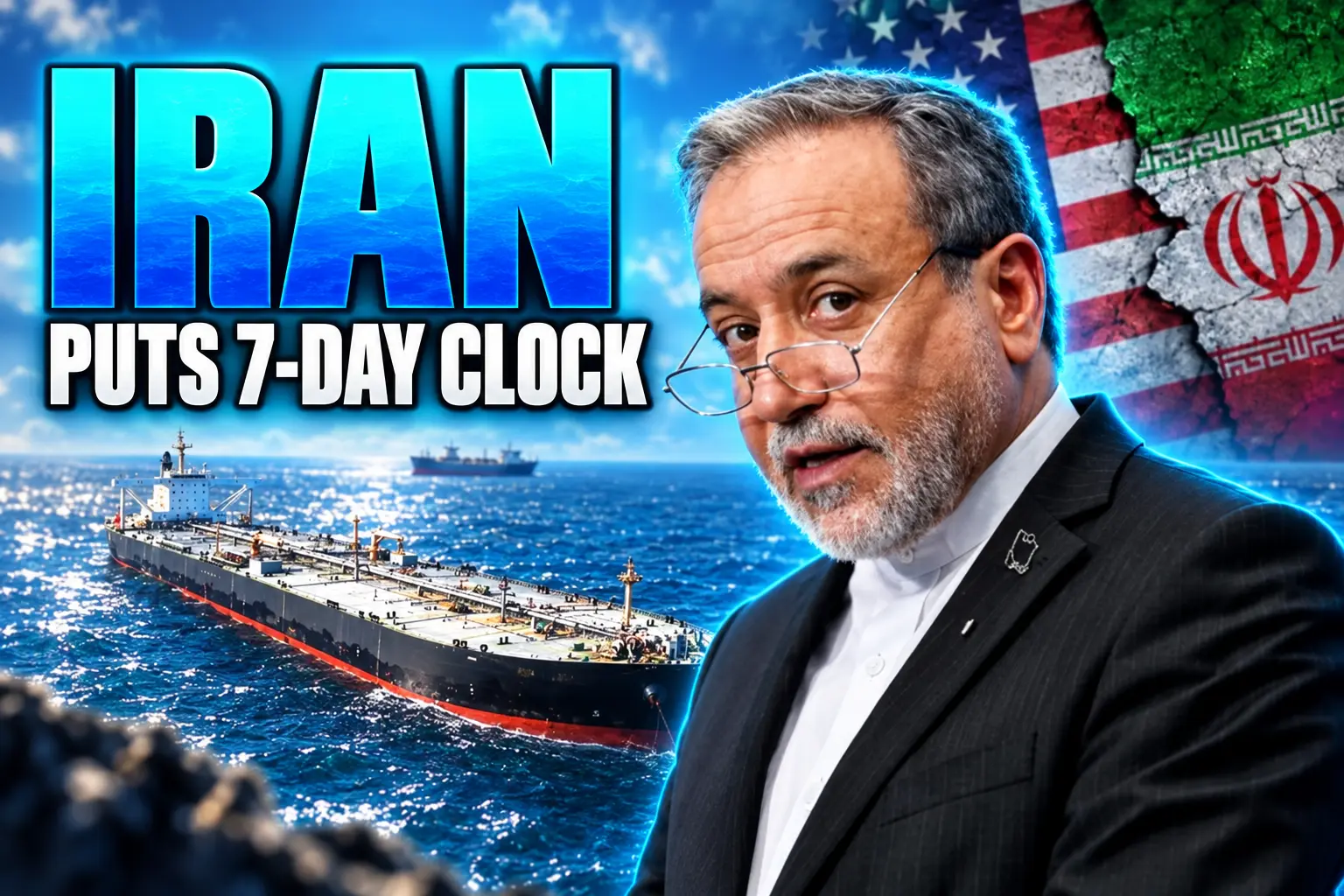
Iran’s Hormuz Offer Puts a Seven-Day Clock on Washington
Iran’s seven-day Hormuz plan asks Washington to accept an Iran-Oman lane, while the U.S. says it already controls the strait and can wait.

Iranian Foreign Minister Abbas Araghchi said Friday that a seven-day plan to reopen the Strait of Hormuz now rests with the United States. He told reporters in New York that ships could move again within a week once Washington accepts terms sent through Qatar. A U.S. official said the Trump administration is in no rush, and that American forces already control the waterway.
The plan would have Washington accept a shipping lane Iran and Oman designed, one that puts inbound traffic and part of the outbound track in Iranian waters. That is a different product from a simple reopening of the old international lane.
A Seven-Day Plan Built From a Dead Deal
Araghchi spoke after indirect talks through mediators on the sidelines of the United Nations General Assembly. He said Iran had sent a concrete seven-day plan through Qatar, and that the clock starts only when the United States accepts it.
If the necessary measures are taken, we believe that we can complete the process within four or five days in a way that the Strait of Hormuz is opened on the sixth day, and the United States enters for a final agreement on the seventh day.
Abbas Araghchi, Iranian foreign minister, U.N. stakeout in New York
He told reporters the required U.S. steps already sit inside the June memorandum of understanding, the 14-point text signed on June 17, 2026, after Pakistan’s good offices and Qatari support. “They fall already under the commitments of the United States, so we don’t see any difficulty to implement them,” he said. One named condition, which he had set out a day earlier, is U.S. acceptance of the Iran-Oman transit route.
WHAT THE SEVEN-DAY CLOCK REQUIRES
- U.S. acceptance: Araghchi said the seven days start the moment Washington says yes, and that a Friday yes would have started the clock on Saturday.
- Four or five days: He said the United States can take the required steps in that window because they were already written into the June deal.
- Day six: Iran would reopen the strait, in his sequence, after those U.S. steps.
- Day seven: Washington would come in for a final agreement, with nuclear talks described as the next stage rather than the first.
- The Oman route: The United States would have to accept the maritime corridor Iran and Oman have already mapped.
He also said Iran does not accept coercion, and that “diplomacy is not surrender.” The June text is the same document that collapsed after fresh strikes in early July, which is why the new clock is a political instrument as much as a shipping schedule.
The June Deal Collapsed in Days
Paragraph 5 of the June memorandum said Iran would use its best efforts for safe passage of commercial vessels with no charge for 60 days, with traffic starting at once and, given demining and the removal of military obstacles, restored within 30 days. The same clause sent Iran into talks with Oman on future administration and maritime services. A companion clause said the United States would begin lifting its naval blockade of Iranian ports and finish that job within 30 days.
Araghchi said that, within two weeks of the memorandum, maritime traffic had recovered to about 60 percent of its pre-war level, a figure that comes from Tehran, not from an independent tracker. He said later U.S. measures and military action then blocked the deal. Washington has blamed Iranian attacks on commercial ships, including strikes on vessels using the southern route along Oman, for the breakdown.
FROM CLOSURE TO THE SEVEN-DAY OFFER
- February 28, 2026: Araghchi said the strait was still open until this date, the day U.S. and Israeli operations against Iran began.
- March 4, 2026: Iranian forces declare the strait closed and attack ships trying to transit, according to a Congressional Research Service update.
- June 17, 2026: Donald Trump and Masoud Pezeshkian sign the Islamabad memorandum, including 60 days of free transit and a 30-day U.S. blockade wind-down.
- Early July 2026: The memorandum collapses after attacks on shipping and U.S. strikes on Iranian territory.
- August 25, 2026: Araghchi and Omani Foreign Minister Badr Albusaidi meet in Tehran on a temporary corridor and joint mine clearing.
- September 25, 2026: Araghchi, in New York, says the seven-day plan is in American hands.
- September 26, 2026: Trump posts an image of the waterway labelled “Trump Strait.”
The June wording left “arrangements” and “best efforts” undefined, and it never named a single agreed lane. That gap is what Iran and Oman have been filling, and what Washington is now being asked to bless.
Tehran Wants Both Directions in Its Waters
Kazem Gharibabadi, Iran’s deputy foreign minister for legal and international affairs, said in late August that the agreed entry “would be through our territorial waters, and part of the exit route would also be through our territorial waters.” He put the corridor at seven miles wide. He also said the deal with Oman “does not mean opening the Strait of Hormuz. It means closing the southern route, which was opened by the United States.”
That southern route is the U.S.-backed corridor through Omani waters, run with American naval oversight after the old International Maritime Organization traffic scheme became unusable. Iran has never recognized it. Gharibabadi said Tehran no longer accepts the old mid-strait scheme either, arguing it sits mostly in Omani waters and leaves Iran unable to watch the ships that pass.
Noam Raydan and Farzin Nadimi, writing for the Washington Institute in August, described the 1968 traffic scheme in Omani waters as the peacetime default: two inbound and outbound lanes, each two nautical miles wide, separated by a two-mile zone, with the deep channels predominantly on the Omani side of the median line. After the June memorandum, they wrote, overall crossings rose to about 45 a day, then fell to about 13 after the deal died and Iran hit tankers on the Omani route. More ships, they said, were using Iranian lanes south of Larak Island than the Omani corridor, and “dark” transits with AIS off were rising.
Oman had floated an equal split and, later, a regional setup with voluntary fees modelled on the Malacca cooperative mechanism. Tehran rejected the equal split. Its counteroffer keeps one full direction, and part of the other, inside Iranian waters so that Iran can watch both inbound and outbound traffic.
20.9 Million Barrels Used to Move Each Day
Before this war, the strait was the main door for Gulf crude heading to Asia. The U.S. Energy Information Administration’s chokepoint series puts first-half 2025 oil flows through Hormuz at 20.9 million barrels a day, about 20 percent of world petroleum liquids use and about a quarter of seaborne oil trade. The waterway is 22 nautical miles across at its narrowest, with those two-mile lanes inside it.
PRE-WAR HORMUZ OIL
- Daily oil: 20.9 million barrels a day in the first half of 2025, EIA tanker-tracking analysis.
- Share of use: About 20 percent of global petroleum liquids consumption, same series.
- Bypass pipes: About 2.6 million barrels a day of spare capacity on Saudi Arabia’s East-West line to the Red Sea and the UAE line to the Gulf of Oman, the figure CRS cites from EIA.
- Width: 22 nautical miles at the narrowest point, per the August CRS update, with two-mile lanes and a two-mile buffer.
Those pipes cannot replace the strait. They are a relief valve, not a second Hormuz. That is why a fight over which painted lane counts as “open” still moves the oil market even when some cargoes are already sneaking through under escort, with transponders off, or by ship-to-ship shuttle in the Gulf of Oman.
THE THREE HORMUZ ROUTES
| Route | Who backs it | Where the water sits | Status |
|---|---|---|---|
| IMO traffic scheme (1968) | International Maritime Organization practice | Mostly Omani territorial waters, mid-strait | Unusable for many operators; mines and wartime risk |
| Southern corridor | U.S. Navy escorts with Oman | Along the Omani coast | In use under escort; Iran does not recognize it |
| Iran-Oman temporary corridor | Iran and Oman diplomats | Entry in Iranian waters; part of the exit in Iranian waters | Mapped, not opened; U.S. acceptance demanded |
A “reopening” that adopts the third row is, in Gharibabadi’s own words, a closing of the second. That is the swap inside Araghchi’s seven days.
Why Washington Says It Can Wait
The unnamed U.S. official said the administration is having “positive and constructive discussions” through the mediators. The same official said, “The United States is in a very strong position with control of the Strait of Hormuz, so we are not in a rush.” Over the last 48 hours, the official added, nearly 40 million barrels of oil had transited the strait.
That barrel figure is a U.S. claim, not an EIA print, and it sits beside a year of fighting over whose ship counts are real. Earlier in September, vessel-tracking firms published daily transit numbers far below peacetime norms, even on days when American officials described large escorted convoys. The two pictures can both be in play: some oil is moving under U.S. protection, and the old, thick stream of unescorted traffic has not returned.
WHAT WE KNOW
- The messenger: Qatar has the seven-day plan; Araghchi presented it in New York on September 25, 2026.
- The named condition: U.S. acceptance of the Iran-Oman route is on the list.
- The U.S. line: Washington says it already controls the strait and is not in a hurry.
WHAT IS UNCONFIRMED
- The full text: Iran has not released the complete seven-day paper, only the clock and the claim that the U.S. steps are already in the June deal.
- The barrel print: Independent trackers have not corroborated the official’s 48-hour total of nearly 40 million barrels.
- An American yes: Trump has not accepted the plan in public. Early Saturday he posted a map labelled “Trump Strait.”
Paper oil still jumps on any headline that the strait might reopen, then gives the gain back when the politics stall. Street fuel does not move as fast as the futures screen. That lag is one reason a White House that claims barrels are already moving can treat Araghchi’s clock as optional.
Oman Has to Live With Either Map
Oman is the other coastal state. It is a party to the U.N. Convention on the Law of the Sea; Iran is not. Under the convention’s Part III, ships in a strait used for international navigation enjoy a right of transit passage that “shall not be impeded,” and coastal states may not suspend it or charge a toll for the mere act of going through. They can regulate safety, in consultation with the IMO, if the rules do not eat the right itself.
Iran’s 1993 maritime law treats the water as a zone of innocent passage and prior leave. Muscat has been willing to talk about a temporary corridor and mine clearing. It has not signed up for a system in which Tehran holds a veto over who enters the Gulf, or in which a fee for “services” becomes a toll by another name. Albusaidi left the August meeting in Tehran saying he hoped the two countries would soon announce the temporary corridor, with permanent management later.
If Washington accepts Iran’s map, Oman becomes the junior partner on a lane drawn to keep both directions under Iranian eyes. If Washington refuses, Oman remains the host of a southern corridor that Iran keeps hitting. Either way, the coastline that actually holds the old deep-water channels is the one being asked to absorb someone else’s war.
Pezeshkian Is Racing the Midterm Calendar
Iranian President Masoud Pezeshkian said Saturday that resolving Hormuz “is possible through negotiations, not the use of force,” and that his government does not “trust” talks with Washington. Two days after Trump said he believed Iran would wait until after November’s elections, Pezeshkian told a small group of reporters, “We don’t want it to get to the midterm elections.”
Trump has said the opposite. “I believe we’ll make a deal right after the election because it doesn’t make sense for them not to,” he said. “They’re waiting to see how I do in the midterm election.” In the days before Araghchi’s offer, he said he was still considering whether to “annihilate” Iran or make a deal. One national poll found 31 percent of respondents approved of his handling of the Iran war, and 69 percent disapproved.
The pressure campaign around the talks is not only naval. The United States this week said it would sanction any global company doing business with Iranian airlines, with the aim of grounding the civil fleet. Iraq said Saturday it was asking Washington for exemptions so humanitarian flights, for medical treatment, study, and pilgrimage, could use certain Iraqi airports. Flights to Oman, Georgia, and Azerbaijan were also halted. Tehran is trying to cash a shipping concession before American voters sit; Washington is trying to hold the waterway, the blockade, and the calendar at once.
Germany Drew a Toll-Free Line
Europe’s public line, delivered to Araghchi in New York, is that the strait has to reopen without a toll and without a political test at the entrance. Germany’s foreign minister told him Iran must engage in talks to end the conflict and “unconditionally open the Strait of Hormuz, ensuring free, safe and toll-free navigation for all.”
Iran must engage constructively in talks for a sustainable solution to end the conflict in the region & unconditionally open the Strait of #Hormuz, ensuring free, safe and toll-free navigation for all. – @AussenMinDE in a meeting with Foreign Minister @araghchi at #UNGA81
— GermanForeignOffice (@GermanyDiplo) September 23, 2026
That formula collides with the map Tehran brought. A corridor that requires U.S. blessing, sits in Iranian waters in both directions, and is sold as the price of ending a blockade is not unconditional, and it is not the 1968 scheme. It is a bid to turn wartime control of one shore into the operating system for the Gulf’s front door.
Araghchi said that if Washington accepted on Saturday, the seven days would have started then. Trump posted a picture instead, and a U.S. official said America was not in a rush. Until someone starts that clock, the strait stays a contested lane with a new name on a presidential map.

Iran’s Hormuz Offer Puts a Seven-Day Clock on Washington

Palantir Prints Tesla-Like Profit as Cybercab Hits Austin

Cleveland Bets on Classroom AI as New York Hits Pause

Logitech MX Keypad Arrives in India With a Copilot Hook

HP Wraps NVIDIA’s Chip in OmniBooks After a Share Rally

How to Dress for an Interview Men – The Dos and Don’ts of Professional Attire

Miami-Dade Sent Rockstar a Vice City Wish List
HP Wraps NVIDIA’s Chip in OmniBooks After a Share Rally

Canada’s Matched Tariffs Expose a Supply Chain It Shares

Australia Offers a Feed Switch and a Duty on Chatbots
-
 BUSINESS3 years ago
How to Dress for an Interview Men – The Dos and Don’ts of Professional Attire
-
 GAMING3 weeks ago
Miami-Dade Sent Rockstar a Vice City Wish List
-
 BUSINESS3 weeks ago
HP Wraps NVIDIA’s Chip in OmniBooks After a Share Rally
-
 BUSINESS3 weeks ago
Canada’s Matched Tariffs Expose a Supply Chain It Shares
-
 NEWS3 weeks ago
Australia Offers a Feed Switch and a Duty on Chatbots
-

 NEWS3 weeks ago
Stolen Logins Now Talk to the Company’s AI Agents
-

 NEWS3 weeks ago
Pinterest Turns a Shopping Guide Into a Q4 On-Ramp
-
 NEWS3 weeks ago
Logitech MX Keypad Arrives in India With a Copilot Hook