
NEWS
Pinterest Turns a Shopping Guide Into a Q4 On-Ramp
Pinterest’s four-step shopping guide funnels brands into catalogs, tags and Performance+ ads just as holiday planning starts in September.

Pinterest is sending brands a four-step shopping promotions path that starts with a product feed, a tracking tag and AI-run campaigns. The company reported 640 million monthly users in the second quarter, and it says people open the app to shop.
The how-to landed on June 25. A July holiday note then told marketers to be live from September, which is why a basic guide is moving again as fourth-quarter budgets get set.
A Four-Step Guide That Starts With Your Feed
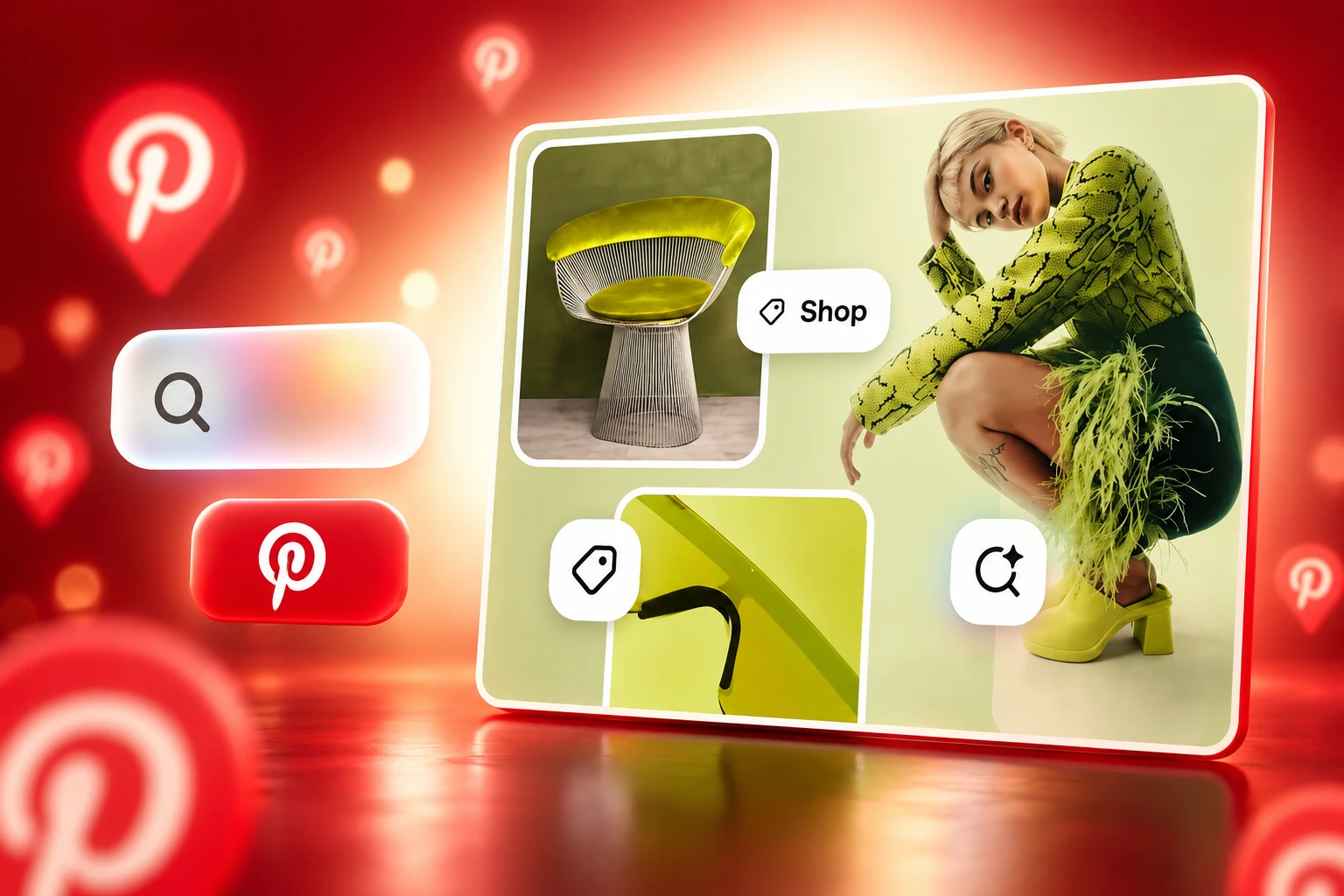
Pinterest’s four-step shopping ads starter guide does not open with creative tips. It opens with plumbing. Brands are told to set up a shop, create product Pins, connect a catalog so listings stay current, and fire the Pinterest tag so conversions can be seen.
Only after that does the company talk about ads. Step two points at the Pinterest Trends tool, then at Performance+, the AI suite that takes targeting, bidding and creative delivery, then at dynamic retargeting, Local Inventory Ads and promotions. Step three is measurement. Step four is Pinterest Academy’s Shopping Essentials track, which the company says can be finished in less than a day.
THE FOUR-STEP SHOPPING ON-RAMP
| Step | Pinterest’s ask | What the brand hands over |
|---|---|---|
| Build foundations | Shop, product Pins, catalog, Pinterest tag | Inventory feed and conversion data |
| Launch and automate | Trends, Performance+, retargeting, local ads, promotions | Targeting, bidding and creative control |
| Measure and optimize | Analytics and a defined success metric | Ongoing signal quality |
| Supercharge skills | Academy Shopping Essentials | Time inside Pinterest’s training stack |
That order is the point of the document. A brand that skips the feed still cannot run catalog shopping ads, and a brand that skips the tag cannot prove the return Pinterest wants to sell.
Pinterest Wants the Catalog Before the Campaign
Before a first shopping campaign, the guide says, a brand needs “a solid presence on Pinterest so your products sync seamlessly with the platform.” Catalogs can arrive through ecommerce integrations, the Pinterest API for Shopping, or a direct merchant feed. The tag is framed as the baseline for return on ad spend.
A June 29 checkup went further. Pinterest said the feed shapes who you reach, what they see and how often you enter the auction, and it told brands to upload a product catalog and feed that is complete rather than a small hero set. Titles that include brand keywords have been associated with 28% higher ROAS. Pattern keywords have been associated with 22% higher ROAS.
Ad groups with fewer than 100 SKUs have been associated with 13.6% lower ROAS, while groups with at least 500 SKUs tend to do better because the system has more to learn from. In other words, the “foundation” is a full, searchable inventory file, not a handful of lifestyle Pins.
Agencies that already buy the app treat that file, plus a conversion tag and the Conversions API, as the real on-ramp. Branded awareness Pins are the side dish. Catalog sales are the meal, especially for smaller shops that need a cheaper CPM than they get on Meta.
How Performance+ Cuts Setup Work in Half
Pinterest Performance+ is the automated campaign layer for Consideration, conversions and catalog sales. The company says the suite can improve return on ad spend with up to 50% fewer operational inputs, because targeting, bidding, budgets and creative delivery get bundled. Catalog sales campaigns using the suite saw an average 20% CPA improvement against a standard setup, per Pinterest’s Performance+ page.
On the August earnings call, chief executive Bill Ready said advertisers who use these campaigns see better ROAS and grow lower-funnel spend more than twice as fast as advertisers who have not switched. He also said Pinterest had “transformed Pinterest into an AI-powered shopping assistant,” with every Pin personalized by AI. The company’s stated goal is for nearly every lower-funnel campaign to start in an AI-powered setup, with extra controls left for complex buyers.
Ready’s team added Smart Assembly for advertisers with no product catalog, so they can upload several images and let Pinterest assemble the ad. Early alpha testing showed a 6% lift in click-through rate. In June, ahead of Cannes Lions, Pinterest also rolled a new Performance+ creative selection model that picks a variant per impression. In testing, that model raised click volume 7.5% against the prior single-variant model.
The future of discovery won’t be driven by keywords alone. It will be shaped by context, taste and trusted recommendations.
Lee Brown, Chief Business Officer, Pinterest newsroom
Business Assistant, an AI helper inside Ads Manager, is in a closed U.S. beta and is meant to surface breakout trends and Pins to promote. Pinterest MCP, a Model Context Protocol hook, is being shaped with alpha partners including PMG, Pacvue, Dentsu, Havas, Innovid by Mediaocean and Omnicom’s Jump450, so agency copilots can read Pinterest campaign data without leaving their own tools.
Product-Level Promotions Hit a Wall
Promotions are the product the how-to keeps waving at. They are time-bound offers that can sit on standard, shopping, video, carousel, collection and idea ads under Consideration, Leads and Sales. Pinterest says adding a promotion to a shopping campaign produces an 18% lift in conversions. Advertisers who use Local Inventory Ads see online conversion rates 1.7x higher than standard campaigns.
The catch lives in the help docs, not the marketing post. Product-level promotions cannot ride on Performance+ sales campaigns or Performance+ creative Pins. A brand that follows step two all the way into full automation then loses the SKU-level deal layer the same guide is selling. Promotions can still be applied to a whole ad group, and they can still be mapped onto catalog items through a promotion_id field, just not on those Performance+ sales setups.
PROMOTION RULES THAT STILL APPLY
- The rollout: Access is opening in the United States, the United Kingdom, Canada, Australia, France, Germany, Japan, Mexico and Brazil, and advertisers may need a Pinterest rep.
- The cap: Discounts cannot exceed 90%, and the offer on the ad must match the landing page and checkout.
- The bans: Sweepstakes, trade-in offers and discounts on free products are not allowed, and shopping-ad promotions must apply to the product shown.
- The currency rule: Pinterest does not convert symbols or amounts, so the advertiser must pick the right currency for the market being targeted.
That seam is easy to miss if you only read the four-step overview. The overview wants Performance+ and promotions. The product page splits them at the SKU line.
The September Start Pinterest Is Selling
The June guide is evergreen. The July 30 holiday note is why it is in front of marketers now. Pinterest says the number one reason people come to the app is to shop, and that holiday activity spikes as early as September. “If you wait until November to show up, most holiday decisions have already been made,” the company wrote.
The same post told brands to put Performance+ to work heading into the fourth quarter. Recent updates to ad delivery models unlocked a 28% improvement in ROAS during testing for SMB advertisers using Performance+ campaigns with ROAS bidding. A recent study Pinterest cites put average incremental ROAS at 3.71, with more than half of those incremental sales from new buyers, and with the biggest returns going to advertisers who ran the full funnel for months rather than a late sprint.
THE 2026 SHOPPING-STACK CALENDAR
- June 17, 2026: Pinterest unveils Business Assistant, MCP and a new Performance+ creative model ahead of Cannes Lions, plus Ask Pinterest as a limited U.S. experiment.
- June 25, 2026: The four-step shopping ads starter guide publishes, leading with shop setup, catalogs and the Pinterest tag.
- June 29, 2026: A catalog checkup tells brands that weak titles and thin SKU groups drag ROAS down.
- July 30, 2026: The holiday guide says festive activity starts in September and that Performance+ with ROAS bidding lifted SMB ROAS 28% in testing.
- August 4, 2026: Pinterest reports 640 million monthly users and $1.18 billion in quarterly revenue, with Ready calling the app an AI shopping assistant.
The recommended launch window is as early as possible between September and November, then scale into the fourth quarter on the ads that already work. Pinterest also wants campaigns left on through the week between Christmas and New Year, when 55% of weekly users keep buying online and 45% keep shopping in stores.
Who Pays for the Catalog-and-Tag Stack
The people who feel this first are catalog managers and Shopify shops, not brand directors writing mood-board copy. Shopify merchants who have installed the Pinterest app can import discounts into Ads Manager. Automatic discounts other than free shipping flow over on their own. Manual code discounts have to be published to the Pinterest sales channel. Importing a code discount can also apply that code for the Pinner.
That pipe is useful, and it is also another reason the feed has to be clean. A promotion that does not match checkout violates Pinterest’s cohesion rule. Merchant guidelines are due to update on November 12, 2026, which lands in the middle of the same holiday window the ads guide is aimed at.
Smaller advertisers are the other named audience. The 28% ROAS test was on SMBs using ROAS bidding. The 50% input cut is a pitch to teams that do not have a full media bench. Feed-management tools were already passing around the June starter guide in early September, including a Japanese product-feed account that posted the Japanese-language version on September 7. The stack is being sold as less work. It is also more of the account living inside Pinterest’s models.
Agencies get a different bargain. MCP is meant to keep them in their own copilots while still reading Pinterest’s taste and intent signals. The brand still has to supply the catalog, the tag and, if it wants the automated path, the right to let Performance+ pick audiences and bids.
640 Million Users and 80 Billion Searches
Pinterest reported global revenue of $1.18 billion for the second quarter, up 18% year over year and 17% in constant currency, the fourth straight quarter above $1 billion. Monthly users hit an all-time high of 640 million, up 11%, the 11th straight quarter of double-digit user growth. Ready said the app now sees more than 80 billion monthly searches, the vast majority visual and over half commercial, and more than 16 billion boards.
PINTEREST Q2 2026 BY REGION
| Region | Monthly users | Revenue | Growth |
|---|---|---|---|
| Global | 640 million | $1.18 billion | 11% users, 18% revenue |
| U.S. and Canada | 106 million | $880 million | 4% users, 18% revenue |
| Europe | 157 million | $213 million | 8% users, 12% revenue |
| Rest of world | 377 million | $87 million | 15% users, 38% revenue |
The geographic split is the quiet constraint on the shopping pitch. User growth is fastest outside the United States and Canada, where monetization is still thinner. U.S. and Canada users grew 4% while revenue there still rose 18%. Rest-of-world revenue jumped 38% off a small base of $87 million. For the third quarter, Pinterest guided revenue to a range of $1,190 million to $1,210 million, or 13% to 15% growth.
That is the backdrop for a shopping guide that asks for feeds, tags and automated campaigns before the first promotion goes live. Pinterest told brands to keep those campaigns running through the week between Christmas and New Year, when 55% of weekly users still buy online and 45% still shop in stores.

Lerwick’s Late Dredge Is Built for Heavier Energy Ships

Skydance Closes the Warner Deal Under $80 Billion Debt

Modern Warfare 4 Hides Enemy Data to Starve Wallhacks

Apple Watch Series 12 Ships Whoop-Style Scores Without the Band

SteelSeries Arctis GameBuds Return as a $199 Color Drop

How to Dress for an Interview Men – The Dos and Don’ts of Professional Attire

Cleveland Bets on Classroom AI as New York Hits Pause

HP Wraps NVIDIA’s Chip in OmniBooks After a Share Rally

Miami-Dade Sent Rockstar a Vice City Wish List

How Much Do Gymshark Athletes Make – The Income and Sponsorship of the Popular Fitness Brand Ambassadors
-
 BUSINESS3 years ago
How to Dress for an Interview Men – The Dos and Don’ts of Professional Attire
-
 NEWS1 month ago
Cleveland Bets on Classroom AI as New York Hits Pause
-
 BUSINESS1 month ago
HP Wraps NVIDIA’s Chip in OmniBooks After a Share Rally
-
 GAMING2 months ago
Miami-Dade Sent Rockstar a Vice City Wish List
-
 BUSINESS2 years ago
How Much Do Gymshark Athletes Make – The Income and Sponsorship of the Popular Fitness Brand Ambassadors
-

 NEWS1 month ago
Stolen Logins Now Talk to the Company’s AI Agents
-

 BUSINESS1 month ago
Canada’s Matched Tariffs Expose a Supply Chain It Shares
-

 NEWS1 month ago
Australia Offers a Feed Switch and a Duty on Chatbots