
NEWS
Palantir Prints Tesla-Like Profit as Cybercab Hits Austin
Palantir already converts AI software into Tesla-scale profit at 66 times sales, while Tesla’s Cybercab is live in Austin at 14 times trailing sales.

Palantir posted $1.062 billion of second-quarter profit, $52 million short of Tesla, on $1.935 billion of sales. Tesla booked $28.24 billion in second-quarter revenue and $1.114 billion of net income.
Palantir is already getting paid for enterprise AI software. Tesla is still paying to put AI into cars, cabs, and robots, including Cybercab rides that opened in limited parts of Austin on September 3.
Palantir Nearly Matched Tesla’s Profit on a Fraction of the Sales
The quarter ended June 30, 2026, puts both companies on the same scoreboard, and the scoreboard is lopsided. Palantir converted 7% of Tesla’s sales into 95% of Tesla’s net income. Tesla’s operating income fell 57% to $398 million, a 1.4% margin, as it spent through the car business. Palantir’s GAAP operating income was $912 million, a 47% margin.
Q2 2026, SIDE BY SIDE
| Metric | Palantir | Tesla |
|---|---|---|
| Revenue | $1.935 billion | $28.24 billion |
| Year-over-year sales growth | 93% | 26% |
| GAAP net income | $1.062 billion | $1.114 billion |
| GAAP operating income | $912 million | $398 million |
| Free cash flow | $1.220 billion adjusted | -$1.092 billion |
Palantir finished the quarter with $9.2 billion in cash and Treasuries. Tesla held $43.52 billion and still burned $1.092 billion of free cash after $5.789 billion of capital spending. Tesla generated $4.697 billion from operations; the factories, AI buildout, and battery work swallowed it.
That is the irony sitting under every Palantir vs Tesla pitch. The company that already invoices AI is a cash machine on a software cost base. The company building physical AI is a profitable carmaker choosing to look unprofitable for a while.
Where Palantir’s Growth Is Coming From
U.S. commercial is the engine, not a side bet. Palantir said U.S. commercial revenue grew 149% to $764 million, and 28% from the prior quarter. U.S. government revenue rose 90% to $809 million. Combined U.S. sales hit $1.573 billion, 81% of the company, up 115% from a year earlier.
For the first half of 2026, 52% of Palantir’s sales still came from government customers and 48% from commercial ones, with 80% of the half from the United States. The mix is shifting, not flipping overnight. The acceleration is on the company side of the ledger, where Palantir’s Artificial Intelligence Platform connects AI with data and operations on top of Foundry and Apollo.
PALANTIR’S U.S. COMMERCIAL BOOK
- Contract value: U.S. commercial TCV hit a record $2.132 billion in the quarter, up 153% from a year earlier, inside $3.373 billion of total TCV.
- Remaining deals: U.S. commercial remaining deal value rose 124% to $6.238 billion, up 27% from the first quarter, assuming options are exercised and contracts are not cancelled.
- Large closings: Palantir closed 220 deals of at least $1 million, including 98 of at least $5 million and 73 of at least $10 million.
- Rule of 40: 93% sales growth plus a 62% adjusted operating margin produced a score of 155%.
Customers in the company’s own update talk like operators, not demo-watchers. Erica Berthou, a global executive committee member at Kirkland & Ellis, said work that used to take a lawyer days to analyze, discuss, and draft now happens in minutes. Amir Vexler, president and CEO of Centrus Energy, said the firm had identified nearly $300 million in savings so far as it uses AIP on a Piketon expansion. SAP CEO Christian Klein said the two firms are embedding AIP in SAP’s migration toolchain so customers can move to the cloud faster.
Demand for AI sovereignty has now been unleashed. And Palantir is the only company that has demonstrated it can transform tokens into actual economic value.
Alex Karp, Co-Founder and Chief Executive Officer, Palantir Q2 2026 release
Management raised full-year 2026 sales guidance to $8.150 billion to $8.158 billion, 82% growth, and lifted U.S. commercial guidance to more than $3.424 billion, at least 134% growth. Third-quarter sales are pegged at $2.160 billion to $2.164 billion. Adjusted free cash flow for the year is now $4.5 billion to $4.7 billion. Karp has said that pace looks like it can last at least another 18 months. The stock only works if he is roughly right.
45 Cybercabs on Austin Streets
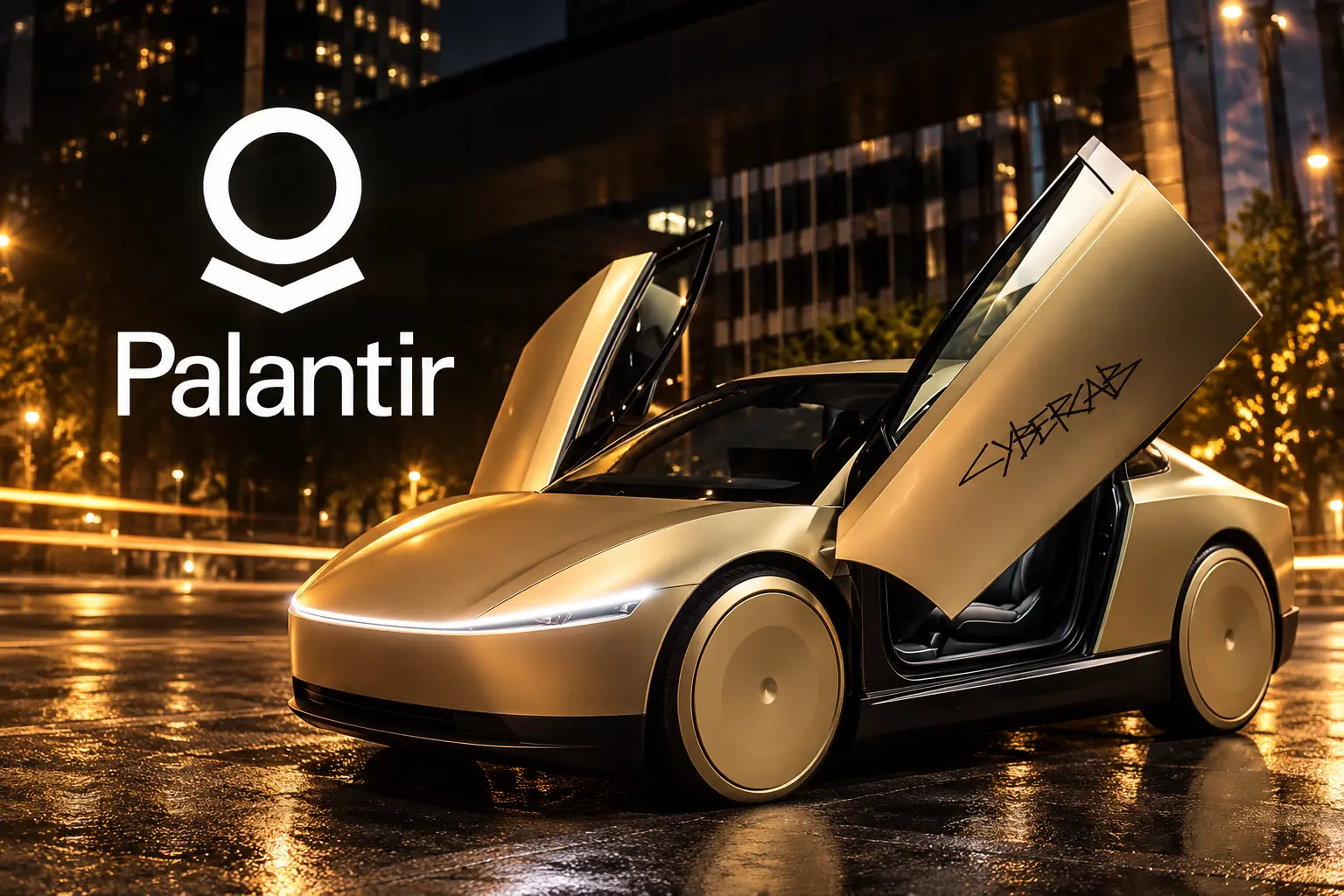
Tesla’s physical-AI story stopped being a slide on September 3, 2026, when the company added the wheel-free Cybercab to paid Robotaxi trips in parts of Austin. Tesla’s own rider pages now list Cybercab rides in limited areas of Austin. Model Y robotaxis still handle Tampa, Miami, Austin, Dallas, and Houston. The Cybercab is a gold two-seater with butterfly doors, no steering wheel, no pedals, and 20.2 cubic feet of trunk, built to run on cameras and Tesla’s software stack.
Texas records showed 45 Cybercabs authorized for driverless use around that launch, inside about 420 Tesla vehicles registered for autonomous operations in the state. The National Highway Traffic Safety Administration said it was in contact with Tesla and evaluating the effort. Federal rules still limit how many cars a maker can field without a wheel and pedals, so the street fleet can stay small even after the factory photos look busy.
TESLA’S 2026 PHYSICAL AI CALENDAR
- June 30, 2026: Quarter closes on record 480,126 deliveries, up 25%, and 1.48 million active FSD subscriptions, up 56% from 0.95 million a year earlier.
- July 22, 2026: Tesla’s update says Cybercab production has started at Gigafactory Texas, with more than 125,000 units of installed annual capacity, and Optimus lines going into Fremont after the Model S and Model X shops were taken down.
- July 2026: Unsupervised Robotaxi service opens in Miami, Orlando, and Tampa, adding Florida to the Texas metros already ramping.
- September 3, 2026: Cybercab joins the paid Robotaxi app in limited Austin zones, with 45 of the two-seaters on Texas books.
Two days before this piece’s sources last checked X, Elon Musk, Tesla’s CEO, quoted the company’s Robotaxi account on an “unboxed” line that builds modules in parallel and frames the car in one step, cutting line size in half. He put the claim in one sentence.
We redesigned Cybercab production for production over 5 times faster than conventional automotive manufacturing! https://t.co/OUpLMI7XoG
— Elon Musk (@elonmusk) September 8, 2026
The argument Tesla wants in the market is manufacturing speed. The argument the street still supplies is a tourist-scale fleet. Riders keep filming the doors and the trunk because a car with no wheel is still rare enough to treat as a prop. Nothing in Tesla’s second-quarter income statement isolates robotaxi fares. Full Self-Driving is the software that is actually selling, 1.48 million paid accounts deep, split between old upfront purchases and subscriptions Tesla is now pushing in most markets.
Tesla Is Spending the Car Business on Autonomy
Automotive revenue was $20.516 billion in the quarter, up 23%. Energy generation and storage added $3.139 billion, up 13%, on 13.5 GWh of storage deployments. Services and other rose 50% to $4.581 billion and posted record gross profit of $648 million. The car, battery, and service stack still pay the bills. AI is where the bills are going.
Operating expenses jumped 47% to $4.353 billion. GAAP gross margin compressed to 16.8%. Adjusted EBITDA margin slid to 11.6%. In its June 30 10-Q, Tesla wrote that it is investing heavily in research and development to accelerate AI, software, and fleet-based profits, “which will negatively impact our profitability during this phase.” That sentence is the strategy. Deliveries can set a record and earnings can still miss, which is what happened: non-GAAP diluted EPS was $0.33.
Production of 451,758 vehicles trailed deliveries, a sign Tesla was shipping out of inventory as well as the line. Model 3 and Model Y were 467,762 of the 480,126 deliveries. Cybercab capacity is listed beside Cybertruck at more than 125,000 units a year in Texas, which is installed gear, not the current run rate. Battery pack capacity, Tesla said, is the main limiter on near-term vehicle volume.
FSD is the one AI product Tesla already collects for at scale. Attach is rising, and the mix is being forced toward monthly payments. That is real software revenue sitting inside a hardware company. It is also still a rounding error next to $20.516 billion of automotive sales, which is why the multiple still looks like a car multiple until robotaxi or Optimus shows up as a line, not a demo.
The 66-Times Sales Price Palantir Now Carries
Palantir closed September 8, 2026, at $170.30. Tesla closed at $368.16. Palantir’s market value on that print was $409.24 billion. Tesla’s was $1.45 trillion, from 3,949,547,394 shares outstanding as of July 16 times that close.
WHAT THE MULTIPLES PAY FOR
| Yardstick | Palantir | Tesla |
|---|---|---|
| Sept. 8 close | $170.30 | $368.16 |
| Market value | $409.24 billion | $1.45 trillion |
| Trailing twelve-month sales | $6.16 billion | $103.62 billion |
| Trailing price to sales | 66 times | 14 times |
| 2026 sales in the price | $8.15 billion guided, about 50 times | No matching full-year sales guide |
A software firm at 66 times trailing sales, or about 50 times this year’s guided $8.15 billion, is priced as if 93% growth is a runway, not a spike. Tesla at 14 times trailing sales of $103.62 billion, after crossing $100 billion over twelve months for the first time, is priced as a manufacturer that might also own the robotaxi and humanoid outcomes. Palantir’s risk is deceleration. Tesla’s risk is that the cabs and robots stay small while the spending stays large.
Comparing those ratios directly is messy on purpose. Palantir barely makes hardware. Tesla pours concrete, stamps metal, and builds 4680 cells. A capital-light 62% adjusted operating margin should clear a higher sales multiple than a 1.4% GAAP operating margin. The gap is still wide enough that “Palantir is the safer AI stock because it already has revenue” skips the price of that safety. You are paying 66 times for invoices that exist. You are paying 14 times for a car company whose AI option is only now taking paid riders in one Texas metro.
After Model S, Fremont Turns to Optimus
Tesla’s Q2 update is blunt about the robot. Fremont’s Model S and Model X lines are gone. First-generation Optimus tools are going in. Early units are meant for an internal “Optimus Academy” that collects training data, not for a shipping product you can order. A second Optimus factory is in works at Gigafactory Texas. Musk has described the start of that curve as slow, because there is no off-the-shelf humanoid supply chain to plug in.
So the physical-AI stack is three clocks at once. FSD software is already on 1.48 million accounts. Robotaxi is live in a handful of Sun Belt metros, with Cybercab limited to parts of Austin. Optimus is a factory conversion. Only the first of those three is material in the current P&L. Palantir’s stack is one clock: more agencies and companies using AIP, then using more of it. That is why Palantir can raise a $2.16 billion quarter and a $8.15 billion year with a straight face, and why Tesla will not give you a robotaxi sales number to match.
Palantir’s third-quarter test is whether U.S. commercial can keep compounding toward that 134% full-year mark. Tesla’s nearer test is whether 45 Cybercabs become a dense Austin grid, then Dallas and Houston, before capex of the last quarter’s size is a habit. Texas has 45 of the gold two-seaters on the books. Palantir is guiding to $8.15 billion of 2026 sales. Those are the live figures, and they still leave both shares expensive for what each has proven.
Disclaimer: This article is news reporting and analysis about Palantir and Tesla as AI businesses, and it is informational only. It is not investment advice, a recommendation to buy or sell either stock, or a prediction of future returns, earnings, or robotaxi or software adoption. Readers should consult a licensed financial adviser or broker who can weigh these facts against their own time horizon, risk tolerance, and portfolio before acting. Share prices, sales multiples, delivery counts, and company guidance here reflect the cited filings, investor updates, and market prints on the dates given and will change as new quarters report.

Lerwick’s Late Dredge Is Built for Heavier Energy Ships

Skydance Closes the Warner Deal Under $80 Billion Debt

Modern Warfare 4 Hides Enemy Data to Starve Wallhacks

Apple Watch Series 12 Ships Whoop-Style Scores Without the Band

SteelSeries Arctis GameBuds Return as a $199 Color Drop

How to Dress for an Interview Men – The Dos and Don’ts of Professional Attire

Cleveland Bets on Classroom AI as New York Hits Pause

HP Wraps NVIDIA’s Chip in OmniBooks After a Share Rally

Miami-Dade Sent Rockstar a Vice City Wish List

Pinterest Turns a Shopping Guide Into a Q4 On-Ramp
-
 BUSINESS3 years ago
How to Dress for an Interview Men – The Dos and Don’ts of Professional Attire
-
 NEWS2 months ago
Cleveland Bets on Classroom AI as New York Hits Pause
-
 BUSINESS2 months ago
HP Wraps NVIDIA’s Chip in OmniBooks After a Share Rally
-
 GAMING2 months ago
Miami-Dade Sent Rockstar a Vice City Wish List
-
 NEWS2 months ago
Pinterest Turns a Shopping Guide Into a Q4 On-Ramp
-

 NEWS2 months ago
Australia Offers a Feed Switch and a Duty on Chatbots
-

 BUSINESS2 months ago
Canada’s Matched Tariffs Expose a Supply Chain It Shares
-

 BUSINESS2 years ago
How Much Do Gymshark Athletes Make – The Income and Sponsorship of the Popular Fitness Brand Ambassadors