
NEWS
Mehta Finds No Traffic Contract in Google AI Overviews Suits
Judge Amit Mehta, who already found Google an illegal search monopolist, dismissed Chegg and Penske AI Overviews suits because an expectation of clicks is not.

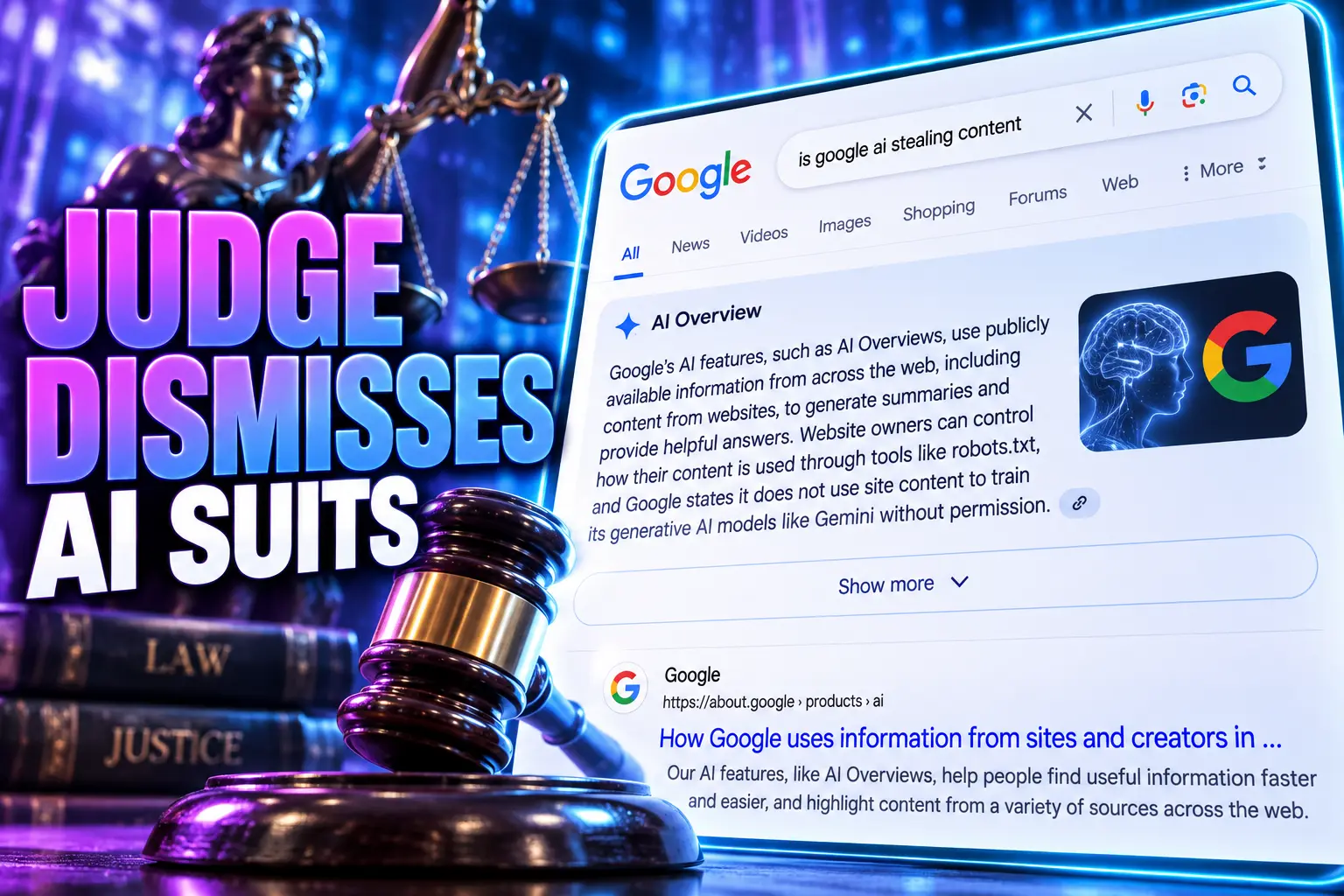
U.S. District Judge Amit P. Mehta dismissed antitrust suits by Chegg and Penske Media over Google AI Overviews on September 30, 2026. He is the same judge who found Google an illegal monopolist in general search in 2024, and he still found no contract that required Google to send those publishers traffic.
Chegg, Penske, and Google did not immediately comment. The federal claims are out. The remaining fight sits in a Google payment test and in a statute Mehta says he cannot write.
Mehta Already Called Google a Search Monopolist
The 41-page memorandum opinion from September 30 opens by placing both cases in a line of private Sherman Act suits aimed at Google’s hold on general search. Chegg, Inc. v. Google LLC is No. 25-cv-00543. Penske Media Corp. v. Google is No. 25-cv-03192. Mehta heard them together on August 25, 2026, then granted both motions to dismiss.
He cited his own liability opinion in United States v. Google LLC, 747 F. Supp. 3d 1 (D.D.C. 2024), and the remedies opinion, 803 F. Supp. 3d 18 (D.D.C. 2025). The publishers had built their complaints on that record. They argued Google used monopoly power in search to coerce free content for AI Overviews, for model training, and for retrieval-augmented generation, then kept users on Google’s page.
That was the bet. A court that had already named the monopoly would treat the lost clicks as an antitrust injury. Mehta did not. He found the reciprocal-dealing counts, the heart of both complaints, failed before the rest of the doctrine even came into play.
The court does not treat Plaintiffs’ alleged harms lightly. Nor is it unsympathetic to the situation publishers now find themselves in, and the knock-on consequences to journalists, educators, and other online creators whose content Google takes and repurposes without compensation. But the antitrust statutes are not in any sense a substitute for a legislative body addressing questions of economic dislocation caused by new innovation.
Amit P. Mehta, U.S. District Judge, memorandum opinion, September 30, 2026
He added that if the case showed gaps in the reach of the antitrust laws, that was for Congress or regulators. The court, he wrote, is bound to apply the law as it is written.
Why the Traffic Bargain Was Never a Contract
Publishers described a quid pro quo they called the fundamental bargain of the commercial internet. They let Googlebot crawl their pages, or they pushed content into the index, and they expected the results page to send users back. Chegg’s complaint called search referral traffic the single most important way online publishers reach users and then sell ads, affiliate links, and subscriptions.
Mehta treated that story as an expectation, not a deal. Plaintiffs pleaded no negotiations, no terms, no quantity of traffic, and no meeting of the minds. They did not allege that Google promised to sell them any specific amount of traffic, or any traffic at all, in exchange for buying their content.
WHAT THE COMPLAINTS DID NOT PLEAD
- An agreement: No communications from which mutual assent to a traffic-for-content sale could be inferred.
- A price or quantity: The closest allegation was an access price of zero, which the court read as publishers acceding to free crawling.
- A sudden pricing shift: Nothing in the pleadings showed a change in pattern that would imply a bargain between these plaintiffs and Google.
- A cited case: Plaintiffs pointed to no court that had recognized reciprocal dealing on facts this thin.
The line that will follow this case is short. “Plaintiffs have pleaded only that they have an ‘expectation’ that Google will send them search traffic if they make their content available for free,” Mehta wrote. “But an expectation is not an agreement. It is simply how a general search engine works.”
He had already rejected a similar agreement theory in Helena World Chronicle. An implied deal inferred from a long course of dealing did not fill the hole. Publishers, he found, keep pages open because traffic serves their own interest.
Section 1 of the Sherman Act needs a contract, combination, or conspiracy. Reciprocal dealing, even under Section 2, still needs two sides: I’ll buy from you if you buy from me. Strip out the agreement and the exclusionary-conduct story has nothing to stand on. Those counts, he wrote, fail to get out of the starting gate.
The Homework Site That Lived on Google Clicks
Chegg filed first, on February 24, 2025. The Santa Clara education company sells study tools and a Chegg Study database it put at 135 million proprietary question-and-answer solutions. Its amended complaint, as recited in the opinion, said it had put hundreds of millions of dollars into that content, and that most new subscribers arrived after students searched Google for homework help.
Chief executive Nathan Schultz tied the company’s options to the feature on the day the suit went in. “These two actions are connected, as we would not need to review strategic alternatives if Google hadn’t launched AI Overviews,” he said. He also said the case was about students losing step-by-step learning to “low-quality, unverified AI summaries.” Google spokesperson Jose Castaneda called the claims meritless then.
CHEGG FIGURES AT THE FEBRUARY 2025 FILING
- Q4 revenue: $143.5 million, down 24% from a year earlier.
- Q4 subscribers: 3.6 million, down 21%.
- Full-year revenue: $617.6 million, down 14%, with 6.6 million subscribers, also down 14%.
- Non-subscriber traffic: Chegg said that stream fell 49% in January 2025 from a year earlier, and it had already announced a 21% staff cut the previous November. Shares closed at $1.57 the day of the filing, down more than 98% from their 2021 peak.
Those numbers do not prove that AI Overviews caused every lost click. They do show a business whose demand arrived through Google’s box. Homework queries are the kind of question an overview can finish on the results page, so the visit never starts and the analytics file never records that Chegg was useful.
Penske Media Corporation followed on September 12, 2025, with Billboard Media, Deadline Hollywood, Fairchild Publishing, Gold Derby Media, Hollywood Reporter, Indiewire Media, Rolling Stone, SheMedia, and Variety Media. The complaint put PMC at more than 120 million monthly visitors in the United States. Most of that reading is free. The money is ads, affiliate commissions, and some subscriptions, all of which need a user to land on the site.
Chartbeat’s 2026 Publisher Playbook, drawn from its news and media clients, found Google Search referrals down 40.2% from July 2025 to July 2026, after a 21.9% drop the year before. Google Discover referrals fell 34.3% in the later year. Search’s share of pageviews across that network went from about 9% in July 2024 to 5% in July 2026. Referrals from AI products grew eight times in two years and still made up 0.01% of traffic.
Search and AI Overviews Count as One Product
Penske also pleaded a tying claim Chegg did not. General search was the tying product in which Google holds monopoly power, and AI Overviews was the tied product forced onto the results page. Users, in that telling, get shoved into a summary designed to keep them on Google instead of being sent to the page that wrote the story.
Mehta held that the complaint did not plausibly allege two products. Demand for Google Search, he repeated from the Helena opinion, is inclusive of demand for AI Overviews and the rest of the results page. “If AI Overviews is a separate product from Google Search, then so is potentially every other type of search result Google delivers.”
Without a separate product, and without a showing that users were forced to take a second good they did not want, the per se tying count failed. The monopoly-maintenance counts failed on standing. Lost referral traffic and ad revenue, the court said, are injuries in publishing markets downstream of search. Publishers are not customers in the threatened search market and are not rivals trying to serve it. An injury that is too secondary does not confer antitrust standing, a point Mehta had already made in Helena World Chronicle and again in Sensory, Inc. v. Google LLC in July 2026.
Attempted monopolization and monopoly leveraging fell with the market definitions. Penske had not quantified Google’s share of online publishing in a way the court would accept. California unjust enrichment claims were not decided. After the federal counts went out, Mehta declined supplemental jurisdiction over them.
The Same Standing Problem in the Local News Case
The September opinion is the third time this court has told publishers that harm in news or education does not, by itself, open the search monopoly docket. Helena World Chronicle, LLC, which publishes the Arkansas title Helena World and the digital Monroe County Argus, sued with Emmerich Newspapers, Inc., a Mississippi group with 25 print papers and 22 sites. They filed on December 11, 2023, as a proposed class of online news publishers indexed since November 2019.
THE PUBLISHER DOCKET IN WASHINGTON
- December 11, 2023: Helena World Chronicle and Emmerich Newspapers file No. 23-cv-03677, alleging Google monopolized online news and tied generative search features to general search.
- February 24, 2025: Chegg files No. 25-cv-00543, the first standalone antitrust case aimed at AI Overviews.
- September 12, 2025: Penske and nine of its titles file No. 25-cv-03192 on the same theory, with a tying count added.
- March 20, 2026: Mehta issues the March 20 dismissal of the local publishers, holding they lacked antitrust standing in general search and had not pleaded monopoly power in online news.
- September 30, 2026: The Chegg and Penske amended complaints are dismissed in one opinion.
Helena had tried to treat Google Search and AI Overviews as separate products and to count Google.com, news.google.com, gemini.google.com, and YouTube as a 66% online news share based on 767.8 billion visits from March 2023 to March 2024. The court would not accept that market. It also found the Clayton Act challenges to older acquisitions time-barred. The September opinion points back to that file and says the new plaintiffs offered no reason to change course.
Payments From $1 Million to Under $1,000
Google’s public answer is product design and a test check. Mrinalini Loew, general manager of Google Search Ecosystem, wrote on June 3, 2026, that AI Overviews has over 2.5 billion monthly users of AI Overviews and that AI Mode has surpassed one billion monthly users. The company says people are more satisfied and search more often, and that the features include more inline links, website previews, Preferred Sources, and subscription labels.
The same post introduced a Search Console toggle that lets a site drop out of generative AI features, including AI Overviews, AI Mode, and AI Overviews in Discover. Sites that opt out get no traffic or impressions from those features. Google said the control is not a ranking signal for classic results. As of August 31, 2026, that toggle and the related insights were rolled out to websites worldwide. Google also published guidance on appearing in AI Search that tells sites to publish unique content, not commodity copy.
A separate AI contribution pilot, which Google has called an early-stage test, pays when the company judges that a page contributed to an answer in AI Overviews, AI Mode, or Gemini. About 100 publishers are in it. Enrolled sites see a monthly earnings figure in Search Console and little else about how the number was built.
PAYOUTS DESCRIBED BY PUBLISHERS IN THE PILOT
| Who | Pay described | How it landed |
|---|---|---|
| One early joiner | More than $1 million a year | A large slice of that site’s revenue |
| A later joiner | $50,000 to $60,000 | A small slice of earnings |
| Several small and midsize sites | Less than $1,000 over several months | About 0.1% of advertising revenue |
Those figures come from publishers in the program, not from a Google ledger, and the companies have not been named. Payments can move month to month without an explanation of which pages earned them. Niche topics with loyal followings, including anime and gaming, have been described as paying better than average. Some larger publishers have stayed out, waiting for a higher rate.
The court did not order Google to enlarge that club. It did not set a price. It found no duty to send the traffic the summaries displace.
A Statute the Court Says It Cannot Write
Ian Crosby and Davida Brook of Susman Godfrey represented Chegg and Penske. Sonal Mehta and David Gringer of Wilmer Cutler Pickering Hale and Dorr represented Google. The opinion leaves the California enrichment counts for another courthouse and leaves the federal antitrust theory where Helena left it.
The opt-out Google shipped worldwide still withholds the AI impressions a site gives up. The contribution pilot still pays on Google’s measure of value. Chartbeat’s network still shows search at 5% of pageviews. Chegg still has to find students who do not stop on the overview. Penske still has to sell ads against readers who never leave Google.
Mehta has now told education, entertainment, and local news the same thing. The monopoly finding in 2024 did not create a private right to the clicks that monopoly produces. If publishers want a rule that Google must pay for the summaries, they need a statute. They do not have one.
Disclaimer: This article is news reporting on a federal court opinion and related company statements. It is informational only and is not legal advice, nor a prediction of any appeal, amended complaint, or licensing outcome. Readers with a live dispute over search traffic, content licensing, or antitrust standing should consult a qualified antitrust or media lawyer before acting. Figures and case statuses reflect the court record and the company and data sources cited as of the dates on those documents and may change if a party refiles, appeals, or amends a program.

Apple Watch Series 12 Ships Whoop-Style Scores Without the Band

SteelSeries Arctis GameBuds Return as a $199 Color Drop

Washington Slows C919 Jet Parts as Rare Earths Stall

Mehta Finds No Traffic Contract in Google AI Overviews Suits

Micron Sells Out 2027 Memory and Leaves PC Buyers the Rest

How to Dress for an Interview Men – The Dos and Don’ts of Professional Attire

Miami-Dade Sent Rockstar a Vice City Wish List

Stolen Logins Now Talk to the Company’s AI Agents

HP Wraps NVIDIA’s Chip in OmniBooks After a Share Rally

Australia Offers a Feed Switch and a Duty on Chatbots
-
 BUSINESS3 years ago
How to Dress for an Interview Men – The Dos and Don’ts of Professional Attire
-
 GAMING4 weeks ago
Miami-Dade Sent Rockstar a Vice City Wish List
-
 BUSINESS4 weeks ago
HP Wraps NVIDIA’s Chip in OmniBooks After a Share Rally
-
 NEWS4 weeks ago
Stolen Logins Now Talk to the Company’s AI Agents
-
 NEWS4 weeks ago
Australia Offers a Feed Switch and a Duty on Chatbots
-

 BUSINESS4 weeks ago
Canada’s Matched Tariffs Expose a Supply Chain It Shares
-

 BUSINESS2 years ago
How Much Do Gymshark Athletes Make – The Income and Sponsorship of the Popular Fitness Brand Ambassadors
-

 NEWS4 weeks ago
Pinterest Turns a Shopping Guide Into a Q4 On-Ramp