
NEWS
Apple Watch Series 12 Ships Whoop-Style Scores Without the Band
Apple Watch Series 12 adds a 0 to 10 Readiness score and five-second heart rate at $399, while Whoop keeps the screenless band Apple may not ship before 2028.

Apple Watch Series 12 now reads heart rate every five seconds and posts a daily Readiness score from 0 to 10. The watch starts at $399 and went on sale September 18, 2026, eight days after John Ternus began the job as Apple chief executive.
Whoop still sells recovery as a membership on a band with no screen. Apple is testing a fabric tracker of that kind, and people briefed on the work say it would not arrive before 2028 if it ships at all.
Series 12 Measures Heart Rate Every Five Seconds
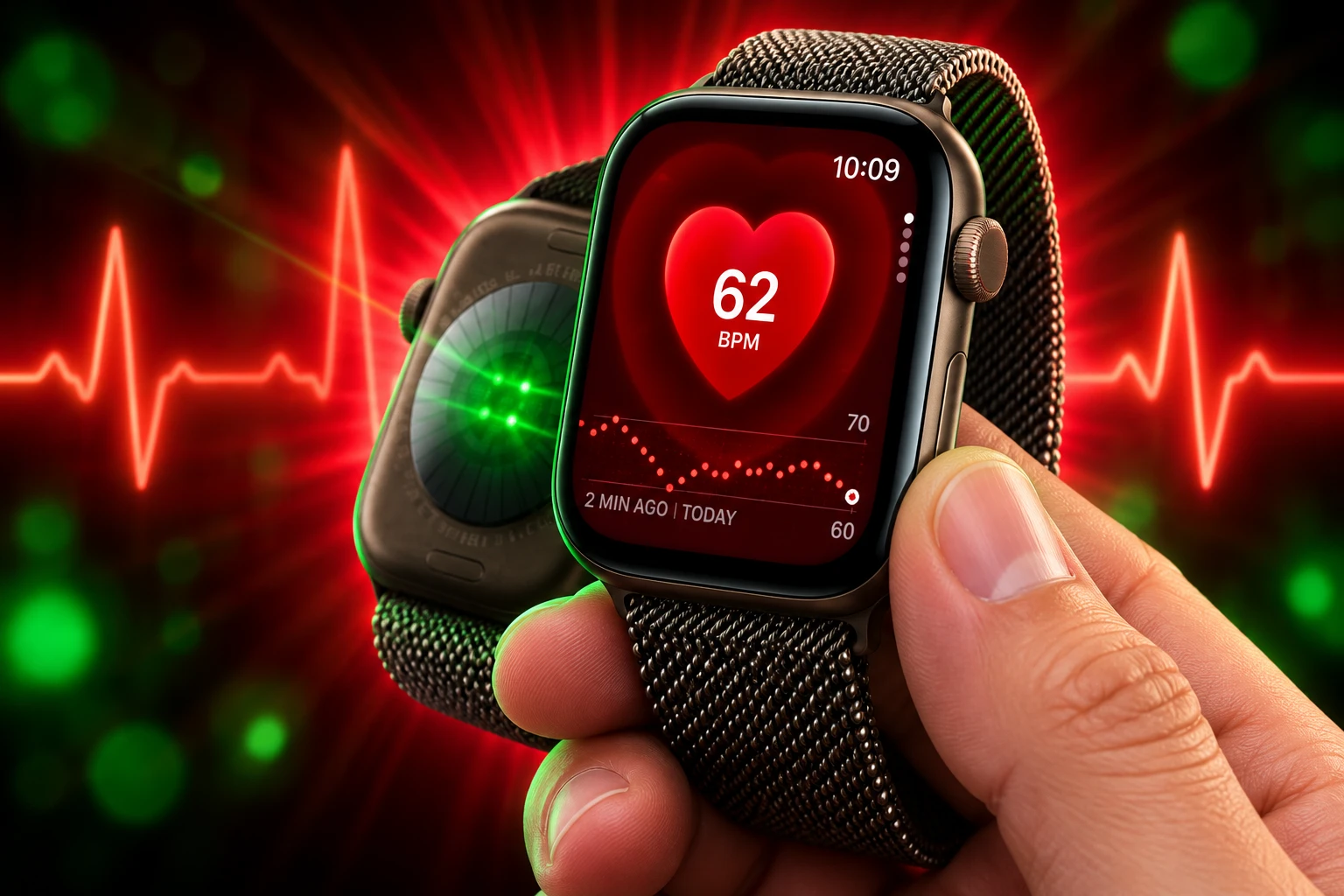
On September 9, 2026, Apple introduced Series 12 and Apple Watch Ultra 4 with a new Health Sensing System and the S11 chip. The optical sensor uses larger, more power-efficient green LEDs. Background heart rate now arrives heart rate every five seconds, all day, which Apple calls 60 times more often than Series 11.
Heart rate variability, the recovery signal Whoop built a business on, is measured as often as every five minutes, 24 times more often than before. The Heart Rate app splits that into Recovery HRV for daily stress and overall HRV for longer-term heart health. Overnight vitals now compare Recovery HRV with a personal baseline. A daytime vitals view lets you toggle the same metrics before they show up in the morning.
Apple cites a study of more than 1,000 people, across demographic groups, that ranked the new Watch highest for heart rate accuracy among the wearables it tested. That is Apple’s own study, not an independent lab ranking you can pull off a shelf.
The first Apple Watch, in 2014, treated heart rate as a curiosity. Eugene Kim, vice president of hardware engineering, still tells the story of a customer who emailed Tim Cook after a low reading sent them to the ER with a blocked artery. Steve Waydo, director of health sensing, said some people on the team keep that mail framed.
Apple Watch Series 12 is the most advanced health and fitness companion we’ve ever created. With our new Health Sensing System and S11 chip, Apple Watch Series 12 gives you meaningful insights, like readiness, so you can better understand how to take on your day and care for your health, plus intelligence features that make everyday life easier. And it’s all wrapped in a beautifully thin, light design you’ll love wearing all day and night.
Kaiann Drance, vice president of Worldwide Apple Watch Product Marketing, Apple newsroom
The case still looks like last year’s Watch. Aluminum models add Ceramic Shield 2. Battery life stays at up to 24 hours of everyday use. Outdoor workouts now get up to 10 hours, 25 percent more than the previous model. A 15-minute charge adds up to 12 hours, 50 percent more than before. You still park it on a puck each night if you want the sleep data that feeds the new score.
Four Labels on a 0 to 10 Score
Readiness lives in its own app on Series 12 and Ultra 4, and in the Fitness app on iPhone. It is not a software gift for older watches. Apple Support lists only those two models. You need height, weight, and age in Health Details, Activity set up, overnight vitals, and Sleep enabled.
The score runs from 0 to 10. Apple’s support page groups it into four labels, written in plain language rather than a 0 to 100 ring.
THE READINESS BANDS
- Go for it: 8 to 10, the top band, for days the watch treats as open for hard work.
- Ready: 5 to 7, a middle band that says you can train without treating the day as a peak.
- Pace yourself: 2 to 4, a warning that load, sleep, or vitals are pulling the number down.
- Recover: 0 to 1, the floor, where the advice is to back off.
The number is built from recent activity, training load, vitals, and last night’s sleep score. It updates through the day after a hard workout or a swing in daytime vitals. Active calories, workout effort ratings, and Training Load all feed it. Higher activity generally lowers the score. Steady or lighter days raise it. Vitals marked Notably or Slightly off cut it. Typical or Favourable vitals, including higher-than-usual HRV, lift it. A weak sleep score drags it; a strong or improving one helps.
You have to sleep in the watch for at least 7 nights, and you had to wear it last night, or you do not get a score. The algorithm was trained on data from the Apple Heart and Movement Study, with exercise scientists and physicians at Apple. Asha Chesnutt, on Apple’s clinical team, said the five-second stream is the part that makes the number feel current. “It’s changing with everything you do,” she said. “So it really helps me understand if I’m behind on my water intake or if I shouldn’t have had that extra cup of coffee.”
Apple’s support page is blunt about the limits. Readiness does not weigh existing conditions or medication. It is a wellness feature, not a green light that it is safe to train.
$199 a Year Still Buys a Screenless Band
Whoop never sold a pretty watch. It sold a strap you forget, a 0 to 100% Recovery score, and a membership. In the United States, a Whoop One membership at $199 a year includes WHOOP 5.0 hardware. Peak is $239 a year with Healthspan and WHOOP Age. Life is $359 a year with the WHOOP MG sensor, ECG, irregular-rhythm alerts, and blood-pressure insights. Battery life on the 5.0 hardware is listed at 14+ days. There is no screen and no nightly puck if you use the pack that charges on the wrist.
That is the product Harry Kane and Declan Rice were paid to wear as Oura ambassadors, and the reason a gold Whoop on Jay-Z photographs like jewelry next to a Daytona. The pitch is that you sleep in it. A Watch that lasts up to 24 hours asks you to take it off in the same window when recovery is measured.
THREE WRISTS, THREE BILLS
| Device | Starting cost | Listed battery | Heart rate | Daily score | Screen |
|---|---|---|---|---|---|
| Apple Watch Series 12 | $399, one-time | Up to 24 hours | Every 5 seconds | Readiness, 0 to 10 | Yes |
| Apple Watch Ultra 4 | $799, one-time | Up to 50 hours everyday, 84 hours Low Power Mode | Every 5 seconds | Readiness, 0 to 10 | Yes |
| Whoop One (WHOOP 5.0) | $199 per year | 14+ days | Continuous, no display | Recovery, 0 to 100% | No |
Three years of Whoop One is $597. That is $198 more than a $399 Series 12, before bands, cellular, or AppleCare. Two years of Whoop One is $398, a dollar under the Watch. Whoop’s hardware is bundled and replaced while you pay. The Watch is a product you buy again when Apple moves the sensors.
Sacra, a research firm that models private companies, put $1.1 billion annualized Whoop revenue on the books exiting 2025, up 103% from the year before, and valued the company at $10.1 billion. That is not a round that dies because Apple put a 0 to 10 score on a watch face. It is a business that already chose athletes, 24/7 wear, and a subscription over a slice of Apple’s installed base.
Launch-day posts treated Series 12 as a funeral for that model. The funeral skips the charging gap. If you take the Watch off at 10 p.m. and put it on at 7 a.m., you did not record the night the score is built on. Whoop’s whole product is that night.
What the Extra $400 on Ultra 4 Buys
Ultra 4 starts at $799, $400 above the aluminum Series 12. Both watches get the same Health Sensing System, the same S11 chip, the same five-second heart rate, the same HRV cadence, and the same Readiness app. Apple wrote the accuracy claim once, from the same study, and applied it to both.
The extra money buys a 49mm titanium case, dual-frequency GPS, satellite Emergency SOS, Messages, and Find My, a 100-meter water rating, a brighter display, and the longer battery Apple lists at up to 50 hours of everyday use and 84 hours in Low Power Mode. It does not buy a better readiness algorithm. If the score is the reason to upgrade, Series 12 is the cheaper door.
Series 12 still has to make it through a workday and a workout on up to 24 hours. Ultra 4 can cover a weekend. Neither matches 14+ days on a Whoop strap. For sleep tracking, that gap is the product.
A Fabric Band That May Not Ship Before 2028
Ternus took over as CEO on September 1, 2026, after Apple’s board named him on April 20 and moved Cook to executive chairman. Cook led the company from 2011. Ternus had run hardware engineering and had been at Apple 25 years. One of the first rumors around that handoff was a screenless tracker.
In late September, people familiar with the work described prototypes of a thin fabric band with a sensor-equipped computing module and no display. The project sat in a stage Apple calls a technology investigation. Even if it proceeds, a commercial device was not expected before 2028. An Apple spokesperson declined to comment. Eddy Cue, who took over health after Jeff Williams left, is said to want simpler, fitness-first interfaces. Cook, now executive chairman, is also described as interested.
FROM CEO DAY TO THE BAND REPORT
- September 1, 2026: John Ternus becomes Apple CEO. Tim Cook becomes executive chairman.
- September 9, 2026: Apple announces Series 12 and Ultra 4, Readiness, and a Health app rebuild for later in 2026.
- September 18, 2026: Both watches go on sale, Series 12 from $399 and Ultra 4 from $799.
- September 22, 2026: Accounts of internal prototypes describe a fabric health band, still unapproved, and not expected before 2028.
That sequence is the joke inside the “Whoop killer” headline. Apple shipped Whoop’s vocabulary on a Watch that still has a glowing rectangle and a nightly charge. The object that would compete with Whoop on wear time is two years out, and it may never leave the lab. Google has already put a screenless Fitbit Air into that gap. Garmin sells bands of its own. Apple is late on purpose or late by habit. Either way, Series 12 is the holding pattern.
A $119 Lab Panel Feeds Health Age
The Watch is only half of the copy. Later in 2026, Apple is rebuilding the Health app on iPhone with Apple Intelligence, first in U.S. English. A new Insights tab will summarize heart, sleep, readiness, fitness, vitals, and cycle data through the day. A Longevity tab will look at longer records across heart, sleep, mood, movement, metabolism, hearing, and nutrition.
That tab includes Health Age in a new Longevity tab, a figure that compares Watch metrics with your chronological age. Apple says the model can use VO2 max, resting heart rate, sleep, and HRV, and that you can add lab values such as A1c and LDL. Whoop already sells WHOOP Age on Peak. Oura sells a cardiovascular age estimate. Apple is arriving with the same idea, tied to a phone most of its Watch owners already hold.
Users will also be able to book labs of more than 50 biomarkers for $119 through the Health app at about 2,000 Quest Diagnostics sites in the United States. Whoop and Oura already run blood panels through similar clinic networks. Apple is folding the order button into Health rather than a third-party membership.
Sumbul Desai, M.D., Apple’s vice president of Health and Fitness, said the company wants “actionable, science-based insights built with privacy at the core,” pairing Watch sensors with the Health app so daily readings connect to longer-term age and lab context. Movement tests on iPhone, using the camera and the Watch, will score flexibility, strength, balance, mechanics, and VO2 max on the device. Apple says no video is stored. Whoop cannot run that test. It also cannot show you the time, take a call, or pay for a coffee. Different jobs.
Waydo still reads the old rescue emails when he needs a lift. “A lot of those letters we still get tell us, ‘I bought my watch for this entirely separate thing and then it told me this important information,’” he said. “And so if we weren’t building something that people wanted to wear, we’d miss all of them.” Series 12 makes that watch better at the job Whoop named. It does not make it a band you forget in bed. Until the fabric prototype becomes a product, Whoop’s night is still its own.
Frequently Asked Questions
Which Apple Watch Models Have Readiness?
Only Apple Watch Series 12 and Apple Watch Ultra 4. The score is tied to the Health Sensing System in those two cases, so an older Watch on watchOS 27 does not gain the Readiness app, and Apple Watch SE is not on the list. If you want the score without titanium or satellite, the $399 aluminum Series 12 is the model Apple points to.
How Is the Apple Watch Readiness Score Calculated?
Apple Support says the number mixes Activity (including active calories, workout effort ratings, and Training Load), daytime and overnight vitals from the Vitals app, and your sleep score. Vitals marked Notably or Slightly off reduce it; Typical or Favourable vitals, especially higher HRV, raise it. You must have slept in the watch last night and for at least 7 nights before that, or no score appears. It does not factor medication or diagnosed conditions.
How Much Does Apple Watch Series 12 Cost Compared With Whoop?
Series 12 starts at $399 with no membership for Readiness. Whoop One is $199 a year in the United States, Peak is $239, and Life is $359, hardware included. Over three years, Whoop One totals $597, which is $198 more than one $399 Watch, while two years of Whoop One is $398. Whoop replaces the strap while you subscribe; Apple sells you a new Watch when the sensors move.
What Is Recovery HRV on Apple Watch Series 12?
Apple now stores two HRV figures. Recovery HRV is the daily signal for stress and bounce-back, compared with your own overnight baseline. Overall HRV is the slower view Apple ties to broader cardiovascular health. Both are sampled as often as every five minutes, which Apple calls 24 times more often than on Series 11, and both sit in the updated Heart Rate app rather than a third-party recovery tool.
Disclaimer: This article is news reporting on Apple Watch Series 12, Ultra 4, and competing wearables, and it is for information only. It is not medical advice, a diagnosis, or a recommendation to buy, wear, or rely on any readiness, heart rate, Health Age, or lab product, and it is not investment advice about Apple, Whoop, or Oura. Talk to a licensed physician before changing sleep, training, medication, or blood work based on a watch score or a consumer lab panel, and talk to a registered financial adviser before treating any company figure as a reason to trade. Prices, features, and shipping dates reflect the company pages and studies cited here as of early October 2026 and can change.

Lerwick’s Late Dredge Is Built for Heavier Energy Ships

Skydance Closes the Warner Deal Under $80 Billion Debt

Modern Warfare 4 Hides Enemy Data to Starve Wallhacks

Apple Watch Series 12 Ships Whoop-Style Scores Without the Band

SteelSeries Arctis GameBuds Return as a $199 Color Drop

How to Dress for an Interview Men – The Dos and Don’ts of Professional Attire

Cleveland Bets on Classroom AI as New York Hits Pause

HP Wraps NVIDIA’s Chip in OmniBooks After a Share Rally

Miami-Dade Sent Rockstar a Vice City Wish List

Pinterest Turns a Shopping Guide Into a Q4 On-Ramp
-
 BUSINESS3 years ago
How to Dress for an Interview Men – The Dos and Don’ts of Professional Attire
-
 NEWS1 month ago
Cleveland Bets on Classroom AI as New York Hits Pause
-
 BUSINESS2 months ago
HP Wraps NVIDIA’s Chip in OmniBooks After a Share Rally
-
 GAMING2 months ago
Miami-Dade Sent Rockstar a Vice City Wish List
-
 NEWS2 months ago
Pinterest Turns a Shopping Guide Into a Q4 On-Ramp
-

 NEWS2 months ago
Australia Offers a Feed Switch and a Duty on Chatbots
-

 BUSINESS2 months ago
Canada’s Matched Tariffs Expose a Supply Chain It Shares
-

 BUSINESS2 years ago
How Much Do Gymshark Athletes Make – The Income and Sponsorship of the Popular Fitness Brand Ambassadors