
BUSINESS
Washington Slows C919 Jet Parts as Rare Earths Stall
Commerce is slowing C919 parts licenses to COMAC, a replay of 2025 that hits a still-Western jet while rare earths stay unresolved.

The Commerce Department has slowed licenses for U.S. aircraft parts headed to China in recent weeks, people familiar with the work said. Officials have also capped how many parts China’s state planemaker, COMAC, may receive, a check against stockpiling.
The squeeze lands on a jet Beijing still cannot finish without Western systems, and it arrives after a Washington summit that left rare earths open.
Commerce Is Slowing the License Tap
This is not a new published ban. People familiar with the Commerce Department’s work described a quieter move: licenses take longer, quantities shrink, and a draft rule sits ready if talks sour. The department and the White House did not comment. The Chinese embassy in Washington also did not comment. After last year’s export curbs, an embassy spokesperson accused the United States of abusing those tools.
U.S. and Chinese officials met in September in New York and Washington on rare earths, farm trade, and advanced computing. Aerospace had mostly escaped President Donald Trump’s tariff rounds, even as engine-coating shops already felt Chinese controls on the metals in those sprays. The parts desk is now being used the same way the engine desk was used last year.
HOW THE SLOWDOWN WORKS
- License pace: Commerce has slowed export licensing for airplane parts bound for China in recent weeks, two people said.
- COMAC caps: The department has been limiting the number of parts licensed to COMAC so the company cannot stockpile.
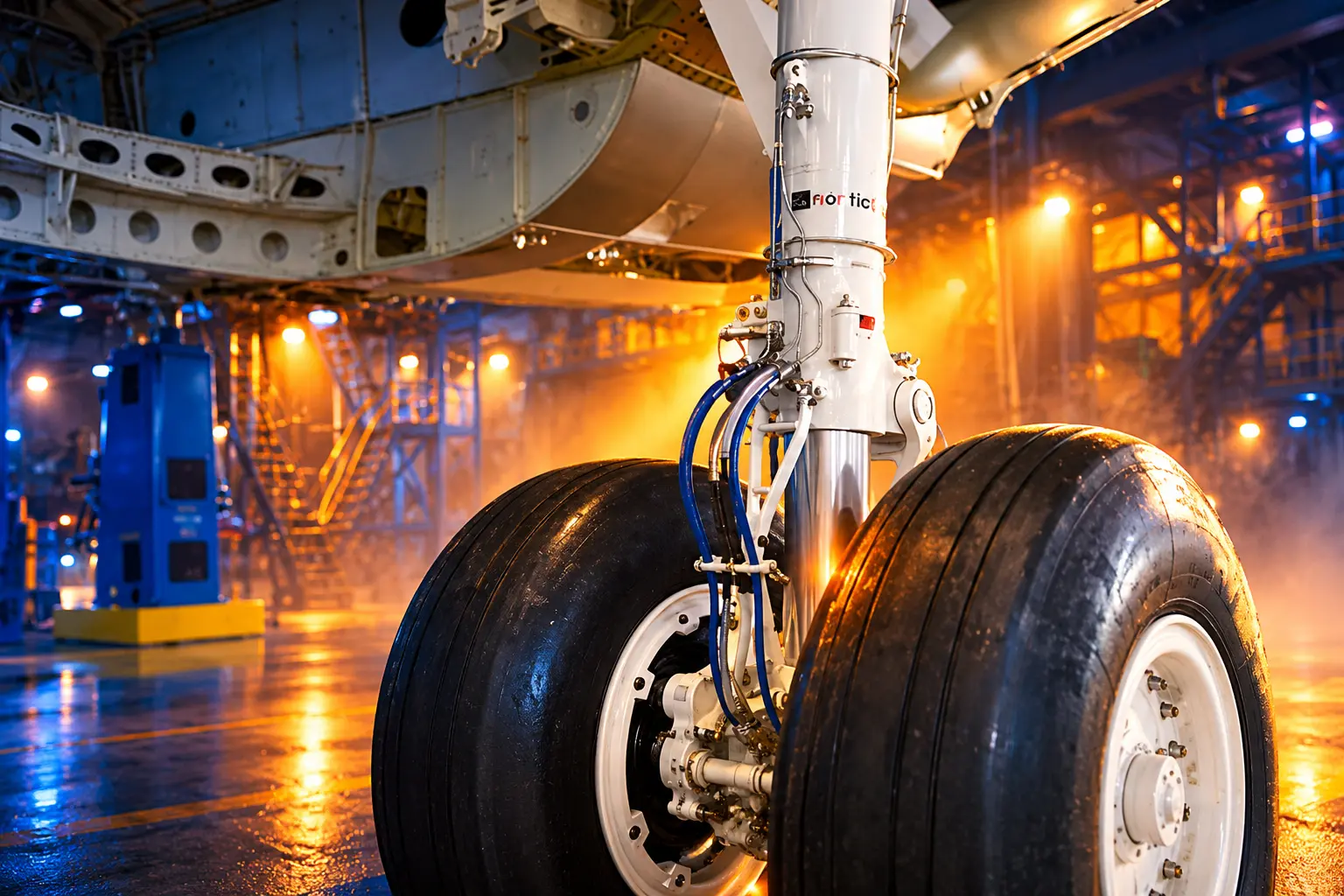
- Landing gear rule: Officials have expressed interest in a regulation that would make it easier to restrict landing gear and other aircraft parts.
- Hydraulic fluid: A draft version added a new licensing requirement on aviation hydraulic fluid shipped by U.S. suppliers such as ExxonMobil.
A cutoff is not required for that package to bite. Certified parts move only when a license moves, so a slower desk can raise pressure when talks stall and ease it when they advance, without a public order that China can answer in kind.
The C919 Still Flies on American Systems
COMAC sells the C919 as China’s first homegrown mainline jet. The airframe is made in China. The systems inside it are not. Airframer, the industry database, puts it plainly: Chinese-Western joint ventures provide the majority of aircraft systems. A CSIS census of major suppliers counted 48 U.S. firms among 94 major suppliers, alongside 26 in Europe, 6 in Asia-Pacific, and 14 in China.
The propulsion choice is the cleanest tell. CFM International, the 50/50 GE Aerospace and Safran Aircraft Engines venture, supplies the LEAP-1C, which Safran still lists as the only Western propulsion system for the C919. GE also supplies recorders, standby displays, and the onboard maintenance backbone. Honeywell puts auxiliary power and flight control systems on the same jet, plus wheels, carbon brakes with Hunan Boyun, and the Laseref VI inertial package. Collins Aerospace, the RTX unit, supplies pilot controls, ice protection, exterior lights, emergency power, and the integrated surveillance suite.
WESTERN SYSTEMS INSIDE THE C919
| Supplier | What it puts on the jet | Caught in the 2025 freeze |
|---|---|---|
| CFM (GE and Safran) | LEAP-1C engines, nacelles, FADEC | Yes; licenses restored July 3, 2025 |
| Honeywell Aerospace | APU, fly-by-wire, wheels and brakes, navigation | Yes, including navigation systems |
| Collins Aerospace (RTX) | Pilot controls, lighting, ice kit, surveillance | Yes; the company declined to comment then |
| Liebherr-AVIC (Changsha) | Landing gear | Draft rule would make gear curbs easier |
| Parker, Moog, Crane | Hydraulics, high-lift, brake-control electronics | In the Western stack Commerce can reach |
Landing gear is the hinge in the new draft. The C919’s gear comes from a Liebherr-AVIC joint venture in Changsha, with Honeywell on the carbon brakes. A rule that makes gear easier to hold would hit that joint venture and, if drawn broadly, the Boeing and Airbus fleets Chinese airlines already park overnight. Hydraulic fluid is even wider. It is a shop fluid, not a C919-only part, which is why ExxonMobil sits in a draft aimed at leverage rather than at one airplane.
Why COMAC Cannot Swap Those Systems Quickly
Those boxes are certified into the type design. Swapping a fly-by-wire computer or a LEAP-1C is not a purchasing decision. It is a new test campaign, then a new sign-off. COMAC is still working with the European Union Aviation Safety Agency on European approval, and Zhang Xiaoyan, chief engineer at the Beijing Institute of Aeronautical Materials, has said domestic substitutes should not interfere with that file.
China is building the AECC CJ-1000A as a home engine. The powerplant is still in airworthiness work. Chinese industry briefings in late September pointed to a 2027 commercial target. Until that engine is on the wing and certified, every C919 that leaves Pudong needs a LEAP-1C that GE can be told not to ship.
May 2025 Already Tested This Choke
Commerce has run this play. In late May 2025 it suspended licenses covering GE engines, Honeywell navigation systems, and other COMAC parts, and it sent letters to hydraulic-fluid makers saying those shipments needed a new license. The fluid letters did not last. The engine freeze did, for about five weeks, and it sat inside a wider round that also hit ethane and chip-design software.
THE ON-OFF SWITCH SINCE 2025
- Late May 2025: Commerce suspends licenses for GE engines, Honeywell navigation gear, and other COMAC parts, and it warns hydraulic-fluid shippers.
- July 3, 2025: The department tells GE it may restart LEAP-1C shipments for the C919 and CF34 shipments for the C909.
- September 24, 2025: Treasury Secretary Scott Bessent names aircraft engines and parts as U.S. levers in the China talks.
- October 2025: Trump says the United States could put export controls on Boeing plane parts after Chinese rare-earth limits.
- Spring 2026: Beijing agrees to buy 200 Boeing jets, then asks for several years of spare parts.
- September 24, 2026: Trump and Xi meet in Washington; the trade truce is extended to January 10, 2027.
- Recent weeks into October 1, 2026: Commerce slows part licenses, caps COMAC quantities, and weighs a landing-gear and hydraulic-fluid rule.
GE confirmed the July restart a few days after the department’s notice. Honeywell did not comment. Collins declined to discuss its licenses. COMAC kept near-term handovers moving on engines and kits already in China. A manager briefed on the planemaker’s books later said things improved substantially in the last quarter of 2025 once more engines and other parts arrived, and that 8 of the 15 jets handed over that year went out in November and December.
We’re not without levers on our side. We have plenty of products that they depend on us for.
Scott Bessent, Treasury Secretary, on Fox Business, September 24, 2025
He listed aircraft engines and parts, certain chemicals and plastics, and the ingredients for silicon. The October 2026 desk move is that list put back to work, after a state visit that did not close the mineral file those engines were first used to pry open.
What China Wants for Those 200 Boeing Jets
The mirror image sits on the Boeing side. China agreed last spring to buy 200 Boeing jets, which would be the planemaker’s first major Chinese-carrier deal in nearly a decade. People familiar with the talks said Beijing then asked for several years of spare parts to go with those airframes. The United States has been reluctant to give that guarantee, seeing the parts as leverage for later rounds. It is unclear where the request stands.
Consistent with US export requirements, Boeing is committed to supporting Chinese airlines with the parts and services they need as we have done for decades.
Boeing spokesperson, statement on the spare-parts request
Planes are not usually sold with multiyear parts guarantees. China’s ask reflects a parts-shortage industry and a political reading of last October, when Trump floated export controls on Boeing parts after Chinese rare-earth limits. Holding those spares now makes the case inside Chinese airline offices for buying fewer Boeings, which is the opposite of what a 200-jet deal was supposed to lock in.
The money is not small. In 2025, China was the top destination for U.S. aircraft and spacecraft exports, taking $15.9 billion of aircraft and spacecraft. That figure covers more than COMAC kits. It is Boeing jets, engines, and the spares that keep existing Airbus and Boeing fleets in China in the air. A license tap aimed at COMAC still runs through the same shops that keep those older fleets flying.
Rare Earths Stayed Unresolved After Xi’s Visit
Xi Jinping’s reciprocal state visit ran September 23 to 25, with White House talks on September 24. The two governments extended a trade truce that had been due to lapse on November 10, giving negotiators until January 10, 2027. They also put the U.S.-China Board of Trade and Board of Investment to work, reached consensus on more favorable tariff treatment for $30 billion of non-sensitive goods in each direction, and recorded a Chinese pledge to import at least 10 million metric tons of U.S. coal in 2027 and again in 2028.
Rare earths did not get that kind of number. The September 25 fact sheet said the two countries would continue to work on rare earth shortages and other critical minerals, with the goal of getting shipment levels back to where Washington wants them. Additional Chinese export curbs that had been due on November 10 stay on ice with the truce. They are not retired.
That is why a slower aviation-license desk showed up days later. The visit produced pandas, coal tons, and a super-intelligence dialogue due by November. It did not produce a mineral flow U.S. officials would call settled. Aircraft parts are the U.S. answer that can be turned without a new statute: already licensed, already sitting in a queue, already essential to a planemaker Beijing cannot replace this quarter.
Eleven Jets This Year Against a Thousand-Plus Orders
COMAC’s problem is volume, not a missing logo. Customer handovers were 13 jets in 2024 and 15 in 2025, after early-2025 talk of 50 jets, then 25, and a supplier-conference capacity figure of 75. A manager briefed on 2026 plans talked of 28 or more. Air China, China Eastern, and China Southern together penciled in 33 C919s for this year, 10, 10, and 13. Through September, handover logs show 11.
C919 HANDOVERS VERSUS THE PLAN
| Period | Jets handed over | What the plan said |
|---|---|---|
| 2024 | 13 | Ramp after 2 jets in 2023 |
| 2025 | 15 | 50, then 25; 75 as a capacity boast |
| 2026 through September | 11 | 28 or more at the factory; 33 at the big three airlines |
Airline fleets plus one COMAC-held jet totaled 43 airframes in late September: 17 at China Eastern, 13 at China Southern, 12 at Air China, and one with the maker. Those fleet counts are not a running sum of the calendar-year handovers above. Industry briefings in mid-September put safe flying time above 150,000 hours, passenger totals above 8 million, and the route map at 26 cities. Firm orders were about 1,150 in August, with disclosed interest near 1,500, including 105 each at Eastern and Southern and 100 at Air China.
On July 20, the Ministry of Industry and Information Technology put cumulative deliveries at 41. Two later handovers, including China Southern’s B-65AY at Shanghai Pudong on September 24, sit on top of that official mark. August saw no customer delivery. A production line that was supposed to settle into one jet every 10 to 15 days is still skipping months. Alternative sources for the hard systems are not sitting on a shelf. That is the opening a slower U.S. license queue walks into.
Beijing Is Already Qualifying Domestic Parts
The political gift is localization cover. At an aviation forum in Guangzhou in August, Zhang said some Chinese-made materials are already on the C919 and others are in COMAC evaluation. One example is HM1176, a domestic sealant used on the C919 and the CJ-1000 program since 2025. The work runs to paints, fasteners, rubber, and cleaners, the dull stuff a jet needs by the crate, because an indigenous industry is not only engines and flight-control computers.
Zhang still conceded that China depends on a small group of U.S. and European firms for some advanced aerospace materials. Honeywell, Collins, Parker, Eaton, Thales, Liebherr, Safran, and Moog remain in the jet. The strategy is evolutionary, not a overnight redesign, in part because a sudden swap would smash the European certification path. Labor and global parts shortages have already slowed the Pudong line. A U.S. license tap adds a political reason to keep that substitution office funded.
Every week a LEAP-1C or a Honeywell box sits in a licensing queue is a week Chinese planners can point to when they ask for money to replace it. The 2025 freeze taught both capitals the same lesson. Washington learned the tap works, because deliveries bunched up only after engines moved again in the fourth quarter. Beijing learned it cannot treat Western kits as a permanent given, which is why the sealant work and the CJ-1000A file were already under way before this latest slowdown.
January 10, 2027 is the date on the truce. The license desk does not have to wait for it. COMAC still needs the same suppliers it needed in May 2025, and rare earths are still the file the September visit refused to close.

Lerwick’s Late Dredge Is Built for Heavier Energy Ships

Skydance Closes the Warner Deal Under $80 Billion Debt

Modern Warfare 4 Hides Enemy Data to Starve Wallhacks

Apple Watch Series 12 Ships Whoop-Style Scores Without the Band

SteelSeries Arctis GameBuds Return as a $199 Color Drop

How to Dress for an Interview Men – The Dos and Don’ts of Professional Attire

Cleveland Bets on Classroom AI as New York Hits Pause

HP Wraps NVIDIA’s Chip in OmniBooks After a Share Rally

Miami-Dade Sent Rockstar a Vice City Wish List

Pinterest Turns a Shopping Guide Into a Q4 On-Ramp
-
 BUSINESS3 years ago
How to Dress for an Interview Men – The Dos and Don’ts of Professional Attire
-
 NEWS1 month ago
Cleveland Bets on Classroom AI as New York Hits Pause
-
 BUSINESS1 month ago
HP Wraps NVIDIA’s Chip in OmniBooks After a Share Rally
-
 GAMING1 month ago
Miami-Dade Sent Rockstar a Vice City Wish List
-
 NEWS1 month ago
Pinterest Turns a Shopping Guide Into a Q4 On-Ramp
-

 NEWS1 month ago
Australia Offers a Feed Switch and a Duty on Chatbots
-

 BUSINESS2 years ago
How Much Do Gymshark Athletes Make – The Income and Sponsorship of the Popular Fitness Brand Ambassadors
-

 NEWS1 month ago
Stolen Logins Now Talk to the Company’s AI Agents