
NEWS
Micron Sells Out 2027 Memory and Leaves PC Buyers the Rest
Micron’s $54.23 billion quarter shows 2027 memory is already committed, leaving PC DDR5 as leftover supply at much higher RAM prices.

Micron Technology posted $54.23 billion in fiscal fourth-quarter revenue, up 379 percent, and said most of 2027’s memory is already committed. Chairman and chief executive Sanjay Mehrotra told investors on Sept. 30 that demand will beat supply in 2027 and 2028, and that those years will run tighter than 2026. The leftover after that book is the DRAM still used to build a PC, and that leftover is what set RAM prices this year.
A $54 Billion Quarter on Price, Not Bits
The quarter ended Sept. 3. Micron’s record fiscal fourth-quarter and full-year results put revenue at $54.23 billion, against $11.32 billion a year earlier and $41.46 billion in the prior quarter. GAAP net income was $37.70 billion, or $32.87 a share, up from $3.20 billion. Adjusted net income was $38.40 billion, or $33.42 a share. GAAP gross margin was 86.8 percent, against 44.7 percent a year earlier.
For the full fiscal year, revenue reached $133.19 billion, up 256 percent from $37.38 billion, and GAAP net income was $84.97 billion, up from $8.54 billion. Operating cash flow was $43.97 billion in the quarter and $89.68 billion for the year. Net capital spending was $27.37 billion for the year, and the company ended with $73.48 billion in cash, marketable investments, and restricted cash. The board declared a $0.15 dividend, payable Oct. 29, 2026.
MICRON’S FISCAL FOURTH QUARTER
| Line | Q4 2026 | Year earlier |
|---|---|---|
| Revenue | $54.23 billion | $11.32 billion |
| GAAP net income | $37.70 billion | $3.20 billion |
| GAAP gross margin | 86.8% | 44.7% |
| Operating cash flow | $43.97 billion | $5.73 billion |
DRAM did the lifting. Fourth-quarter DRAM revenue was $39.8 billion, 73 percent of sales, and up 343 percent from a year earlier. Bit shipments rose only in the mid-single-digit range sequentially, while DRAM revenue rose 27 percent, so selling prices carried the print. Cloud Memory, the unit that sells high-bandwidth memory, posted $16.28 billion at an 83 percent margin. Data-center SSD revenue was nearly $10 billion, more than ten times the year-ago quarter, and more than two-thirds of NAND. Mehrotra said fiscal 2026 DRAM revenue surpassed $100 billion, and he called fiscal 2027 an even stronger year. Guidance for the current quarter is about $61.5 billion of revenue and $38.15 of adjusted earnings per share.
More Than 75% of 2027 Output Is Already Committed
The profit is the easy headline. The book is the mechanism. Mehrotra said more than 75 percent of Micron’s 2027 output is already committed, and that most talks with customers have moved to 2028. Chief financial officer Mark Murphy put remaining performance obligations at about $150 billion, a floor valued at contract minimums. Those figures sit in Micron’s Sept. 30 current report on Form 8-K and in the call that followed it.
The contracts are not forecasts. Micron has signed 26 strategic customer agreements, take-or-pay deals that require the buyer to take committed volume or still pay. The company estimates those agreements at over 35 percent of revenue through 2030. Three-quarters of that expected revenue has a defined pricing framework, and a majority of those use bands with a floor and a ceiling. The rest is reset to market from time to time. Customer financial commitments have risen to $32 billion, the vast majority as cash deposits. Some agreements now run into 2031, including two that were extended by a year.
THE 2027 BOOK IN FOUR FIGURES
- Output locked: More than 75 percent of 2027 production is already committed, and live talks have shifted to 2028.
- Contract count: 26 take-or-pay strategic customer agreements, estimated at over 35 percent of revenue through 2030.
- Floor on the books: Remaining performance obligations of about $150 billion, valued at minimum contract prices.
- Cash posted: $32 billion of customer financial commitments, the vast majority as deposits.
That structure is why a blowout quarter can still leave the stock looking bored. The tape already treated 2026 as a price year. What the call added is that Micron is not keeping a large uncommitted tail for 2027, and that the uncommitted slice will be sold into a market the company itself says is getting tighter. New SCA talks that involve price are being struck off the current market, Mehrotra said, not off last year’s levels.
HBM Takes a Bigger Bite of Every Wafer
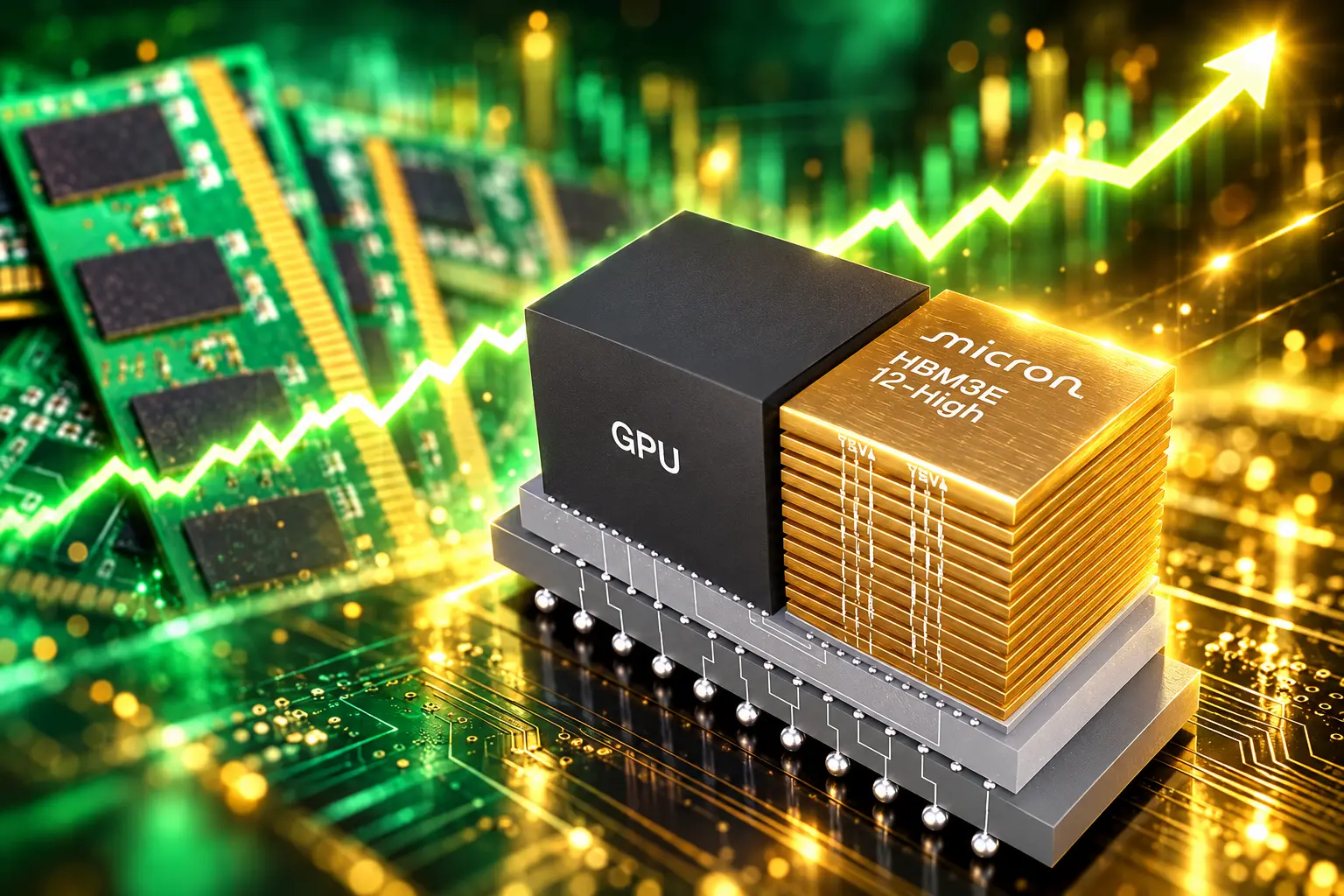
High-bandwidth memory is the product that turns a DRAM wafer into fewer bits and a higher invoice. Mehrotra said Micron has completed agreements for the vast majority of its calendar 2027 HBM bit supply, “with significant price increases year-over-year,” and that those prices are narrowing the gross-margin gap with conventional DRAM. On the same call he said a large part of 2027 HBM volume is already sold out, “and the prices are much higher than 2026 prices.” HBM bit demand, he added, is expected to grow faster than conventional DRAM through calendar 2028. Micron is also building a custom HBM4E stack with NVIDIA, branded NVHBM, for the next round of GPUs and NVLink Fusion platforms.
In fact, we see greater tightness in the industry in 2027 and in 2028 versus 2026. Overall, supply-demand environment is only getting tighter.
Sanjay Mehrotra, Chairman and CEO, Micron earnings call, Sept. 30, 2026
The squeeze on ordinary DRAM is not a side effect in another factory. It is the same clean room. Kim Taewoo, an executive vice president at Samsung Electronics, said on Sept. 29 that HBM is expected to take nearly 30 percent of DRAM makers’ wafer capacity in 2027, up from about 20 percent in 2026. HBM and standard DRAM compete for that capacity, he said, so more HBM means less conventional DRAM. Micron’s own line is that even with extra industry clean-room plans, it has “no line of sight to when supply and demand will return to balance.” Server units are still expected to grow in the high teens in calendar 2026 and 2027, while PC and phone units may fall by double digits, with the remaining demand concentrated in premium machines that want more memory per box.
What a DDR5 Kit Costs After the AI Allocation
Once HBM and server modules have first claim, the consumer kit is priced off whatever dies are left. MemoryIndex, drawing on the DRAMeXchange spot board for DRAM, put DDR5 16Gb dies at $57.53 on Oct. 1, up 4.99 percent over 30 days and 480 percent year over year. A tracked 32GB DDR5 kit (2×16, 6000 CL30) sat at $467.62, up 230 percent year over year. A 64GB kit sat at $1,117, up 250 percent. In August, 128GB kits cleared $3,399. The tracker’s note on those 64GB kits is blunt: consumer modules are now priced off the datacenter bid rather than off PC demand.
DDR5 STREET LEVELS ON OCT. 1
| Product | Level | 30-day | Year over year |
|---|---|---|---|
| DDR5 16Gb die | $57.53 | +4.99% | +480% |
| 32GB DDR5 kit (2×16) | $467.62 | +19.42% | +230% |
| 64GB DDR5 kit (2×32) | $1,117 | +29.42% | +250% |
That is why a mid-range build now treats memory as a line item that can rival the graphics card. OEMs have already been shipping thinner default configs and raising system prices. PC and phone revenue can still grow at the high end, Mehrotra said, even if unit counts drop, because flagship machines are taking the bits. The people assembling a $900 tower do not sit inside those 26 agreements. They buy last.
Idaho and New York Cannot Rescue 2027
Micron is building. It is not building on a 2027 clock. ID1 in Idaho is due to start wafer output in mid-calendar 2027. ID2 is due in late calendar 2028. The first New York fab is due in calendar 2030. A Japan DRAM expansion is due in late 2028. Taiwan’s Tongluo site is due for meaningful shipments in mid-2027. Singapore’s HBM packaging line is due in early 2027, with a new NAND plant in the second half of 2028. First wafers are not full output. Mehrotra said production ramps only gradually after a clean room opens, and that moving from HBM3E to a heavier mix of HBM4 and HBM4E, plus a tougher “trade ratio,” creates a headwind for supply growth. Future node transitions, he said, also give less extra output per wafer.
WHEN NEW WAFERS ARE DUE
- Early calendar 2027: Singapore HBM advanced packaging begins initial output.
- Mid-calendar 2027: Idaho ID1 starts wafer output; Tongluo begins meaningful product shipments.
- Late calendar 2028: Idaho ID2 and the Japan DRAM expansion start wafer output; Singapore NAND follows in the second half of that year.
- Calendar 2030: First New York fab reaches initial wafer output.
So the plants that could loosen 2028 are still shells, and the plants that could loosen 2027 are ramping into a year that is already more than 75 percent sold. Mehrotra used that lag as the reason tightness gets worse, not better, after 2026. “Even after they are built, even after first wafer output, production ramps up only gradually in the clean rooms,” he said. “That’s just the nature of what it takes to bring up production.”
The Consumer Brand Micron Shut in February
PC buyers lost a named shelf before they lost the dies. On Dec. 3, 2025, Micron said it would exit the Crucial consumer business, the brand it had used for 29 years to sell RAM and SSDs to people who upgrade their own machines. Shipments through that channel ran through February 2026. Warranties stay in force. Enterprise product under the Micron name continues. The stated reason was not a factory accident. It was allocation.
The AI-driven growth in the data center has led to a surge in demand for memory and storage. Micron has made the difficult decision to exit the Crucial consumer business in order to improve supply and support for our larger, strategic customers in faster-growing segments.
Sumit Sadana, then EVP and chief business officer, Micron statement, Dec. 3, 2025
That sentence is the consumer version of the 26 agreements. Strategic customers get the wafers, the deposits, and the multi-year floors. Everyone else buys whatever module vendors can still pack from leftover bits, at a die price that is up 480 percent. Other makers still sell retail kits, but they sit in the same wafer math Kim Taewoo described. When HBM’s share of DRAM capacity moves from about 20 percent to nearly 30 percent, the open market does not get a parallel factory. It gets a smaller remainder.
The 2018 Tightness Call Is a Weak Guide
Memory investors have heard a version of this speech before. In 2018, near the last DRAM peak, Mehrotra argued that data-center and AI demand would stabilize the industry and mute the old boom-bust. Prices then rolled over into 2019, and the stock went with them. That history is the fair objection to a CEO who now says he cannot see balance. Cycles do not end because a supplier would prefer they continue, and a sold-out year can still be a peak if customers later cut content or delay servers.
The paper is different this time, which is the only reason the objection does not settle the case. The 2018 upcycle did not come with 26 take-or-pay agreements, $32 billion of customer cash, and a $150 billion remaining-performance book valued at floor prices. It did not come with HBM taking a fifth of DRAM wafers, headed for nearly a third. It did not come after the company had already shut its own consumer brand. Those are not guarantees. They are why leftover DDR5 can stay expensive even if someone on the call is wrong about 2029.
Mehrotra also pointed past the data center, to vehicles and humanoid robots that he said will want more than 200 GB of DRAM plus multiple terabytes of storage per machine, a later layer of content if those products ship at scale. That demand, if it arrives, sits after 2028. The 2027 problem is already sold. PC builders are not waiting on robots. They are paying $467.62 for a 32GB kit because the dies that used to feed that kit were booked, at a higher price, to someone who posted a deposit.
Disclaimer: This article is news reporting on Micron’s Sept. 30, 2026, earnings release, the related conference call, and published memory prices. It is informational only and is not investment advice, a recommendation to buy or sell Micron shares or any other security, or advice on whether to purchase computer memory. Readers who are considering a securities trade should consult a licensed financial adviser, and anyone buying RAM should check live retailer quotes, because spot and kit prices move. Figures, guidance, and contract descriptions reflect the company statements and price trackers cited above and may change.

Lerwick’s Late Dredge Is Built for Heavier Energy Ships

Skydance Closes the Warner Deal Under $80 Billion Debt

Modern Warfare 4 Hides Enemy Data to Starve Wallhacks

Apple Watch Series 12 Ships Whoop-Style Scores Without the Band

SteelSeries Arctis GameBuds Return as a $199 Color Drop

How to Dress for an Interview Men – The Dos and Don’ts of Professional Attire

Cleveland Bets on Classroom AI as New York Hits Pause

HP Wraps NVIDIA’s Chip in OmniBooks After a Share Rally

Miami-Dade Sent Rockstar a Vice City Wish List

Pinterest Turns a Shopping Guide Into a Q4 On-Ramp
-
 BUSINESS3 years ago
How to Dress for an Interview Men – The Dos and Don’ts of Professional Attire
-
 NEWS2 months ago
Cleveland Bets on Classroom AI as New York Hits Pause
-
 BUSINESS2 months ago
HP Wraps NVIDIA’s Chip in OmniBooks After a Share Rally
-
 GAMING2 months ago
Miami-Dade Sent Rockstar a Vice City Wish List
-
 NEWS2 months ago
Pinterest Turns a Shopping Guide Into a Q4 On-Ramp
-

 BUSINESS2 months ago
Canada’s Matched Tariffs Expose a Supply Chain It Shares
-

 NEWS2 months ago
Australia Offers a Feed Switch and a Duty on Chatbots
-

 BUSINESS2 years ago
How Much Do Gymshark Athletes Make – The Income and Sponsorship of the Popular Fitness Brand Ambassadors