
BUSINESS
Lilly’s Amylin Combo Beats Zepbound, Then Loses Patients
Eli Lilly’s EloraTZP amylin-tirzepatide combo beat Zepbound on weight loss in diabetes, but up to 27% of patients quit before Phase 3.

Eli Lilly’s experimental EloraTZP combo cut an average of 23.3% of body weight in 48 weeks, beating tirzepatide 15 mg in people who also have type 2 diabetes. The same high-dose arm sat at the top of the trial’s quit range, with adverse-event dropouts from 10.8% to 27.0%.
Lilly presented the Phase 2b data on September 30, 2026, at the 62nd European Association for the Study of Diabetes meeting in Milan and said it will start Phase 3 by the end of 2026. The 23.3% figure is an efficacy estimand, meaning it describes what happened if people stayed on the assigned shots.
23.3% Weight Loss in People Who Also Have Diabetes
EloraTZP pairs eloralintide, a once-weekly selective amylin receptor agonist, with tirzepatide, the dual GIP and GLP-1 drug sold as Zepbound and Mounjaro. The 48-week trial in the U.S. and Argentina randomized 367 adults with obesity or overweight and type 2 diabetes. Average starting weight was 232.4 lbs (105.4 kg). Average starting A1C was 8.1%.
People on eloralintide 9 mg plus tirzepatide 15 mg lost up to an average of 54.1 lbs, or 23.3% of body weight, and cut A1C by 2.9%. Tirzepatide 15 mg alone lost 34.4 lbs, or 14.8%, and cut A1C by 2.4%. That is an 8.5-point gap and 19.7 extra pounds on the top combo, in a group that usually loses less than people without diabetes.
Lilly said every published combo beat placebo on the primary weight endpoint. Liana K. Billings, M.D., director of clinical and genetics research in diabetes and cardiometabolic disease at Endeavor Health in Evanston, Illinois, and the trial’s lead author, tied the result to hitting more than one hormone at once.
Obesity and type 2 diabetes are interconnected, and we are seeing the potential benefit of targeting multiple hormonal pathways to address both.
Liana K. Billings, M.D., Endeavor Health, EASD presentation via Lilly
ELORATZP 48-WEEK EFFICACY ESTIMAND
| Arm | Weight change | Pounds | A1C change |
|---|---|---|---|
| Elora 3 mg + TZP 5 mg | -13.2% | -30.7 | -2.2% |
| Elora 6 mg + TZP 5 mg | -19.4% | -45.1 | -2.7% |
| Elora 6 mg + TZP 10 mg | -19.9% | -46.2 | -2.6% |
| Elora 9 mg + TZP 15 mg | -23.3% | -54.1 | -2.9% |
| Tirzepatide 15 mg | -14.8% | -34.4 | -2.4% |
| Eloralintide 3 mg | -8.2% | -19.1 | -1.1% |
| Eloralintide 6 mg | -12.3% | -28.6 | -1.4% |
| Eloralintide 9 mg | -11.1% | -25.8 | -1.3% |
| Placebo | -3.0% | -7.0 | -0.3% |
Lilly designed the combo to turn on GIP, GLP-1, and amylin together, with little activity at the calcitonin receptor. Those are hormones the body already releases after a meal. In a earlier Phase 1 study, adding eloralintide 3 mg to tirzepatide 5 mg produced 17% weight loss over 16 weeks, against 10% with that tirzepatide dose alone.
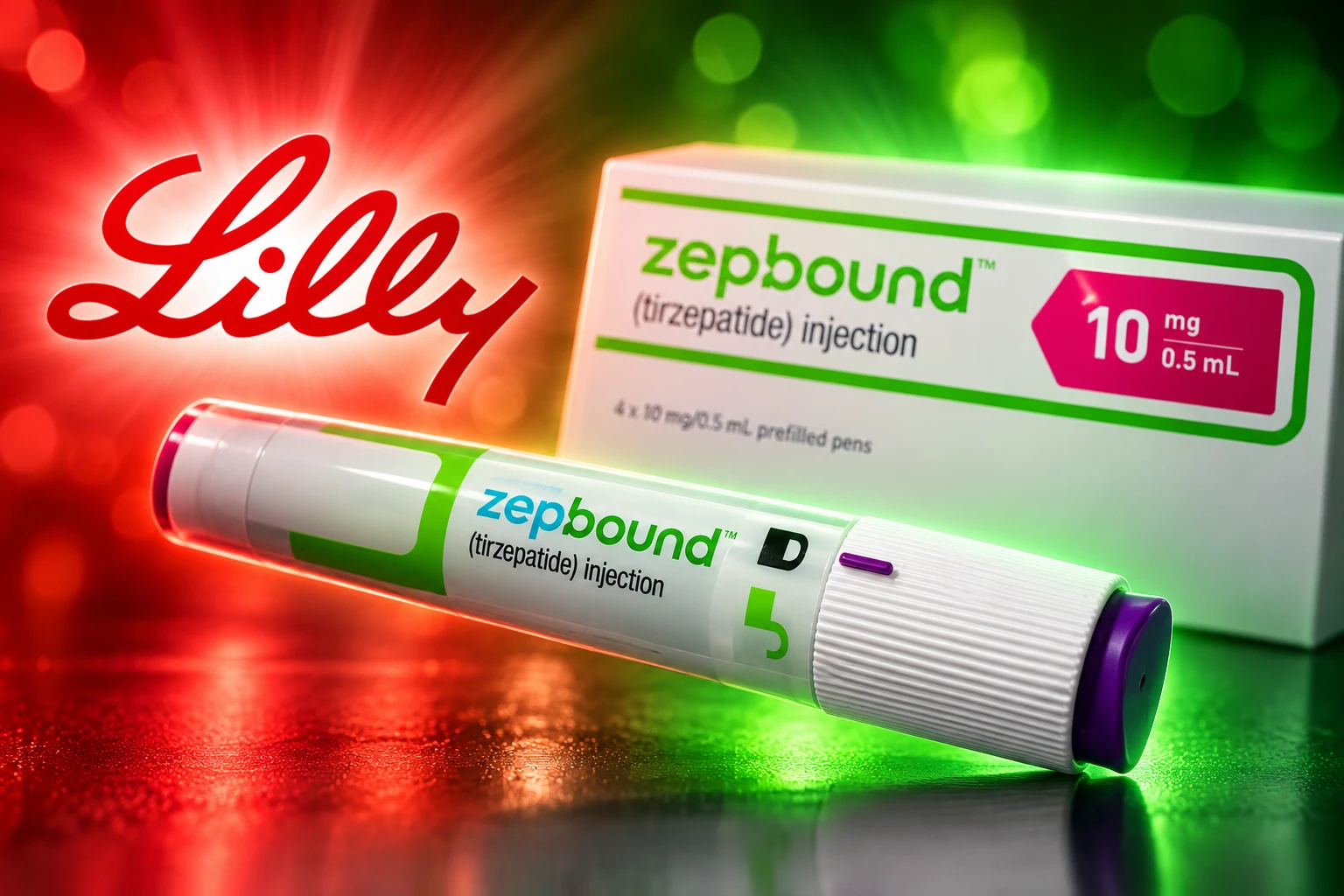
The Same Arms Had the Highest Quit Rates
Gut side effects were more common on the combo than on either drug alone, mostly mild or moderate, and clustered while doses were going up. Treatment stop rates because of adverse events were 10.8% to 27.0% on EloraTZP, 0% to 10.8% on eloralintide, 2.9% on tirzepatide, and 16.7% on placebo. The Milan presentation put the 9 mg plus 15 mg arm at the top of that range, at 27%.
WHO STOPPED FOR SIDE EFFECTS
- EloraTZP arms: 10.8% to 27.0% left because of adverse events, with 27% on the highest dose.
- Tirzepatide 15 mg: 2.9% stopped for adverse events in the same trial.
- Eloralintide alone: 0% to 10.8%, overlapping the low end of the combo range.
- Placebo: 16.7% stopped, a higher rate than tirzepatide and some combo doses.
Kenneth Custer, Ph.D., executive vice president and president of Lilly Cardiometabolic Health, warned against treating those Phase 2 quit rates as the last word. He noted that the highest dose of tirzepatide showed dropout around 25% in a mid-stage trial in 2018, before Lilly changed how it ramped the drug.
It’s probably not the best indicator of the tolerability of a medicine.
Kenneth Custer, Ph.D., president of Lilly Cardiometabolic Health, interview
People in the combo arms started eloralintide at 1 mg or 3 mg and tirzepatide at 2.5 mg, then stepped up every four weeks. That means two ramps at once. One arm waited until week 24 to add eloralintide, starting at 3 mg and moving to 6 mg four weeks later. The EASD presentation showed 20.6% weight loss in that delayed-add arm, with a 13.9% adverse-event dropout rate. Sequential use, not a dual climb, is the version that looks closer to clinic practice.
Lilly did not publish a treatment-regimen weight-loss number that keeps people who quit in the average. The 23.3% headline is the stay-on-drug figure.
Why the Lowest Combo Lost to Tirzepatide
The lowest combo, eloralintide 3 mg plus tirzepatide 5 mg, lost 13.2% of body weight. That is 1.6 points behind tirzepatide 15 mg in the same study. A light amylin dose on a light incretin dose did not beat a full Zepbound dose.
Move the amylin dose to 6 mg and keep tirzepatide at 5 mg, and the picture flips. That arm lost 19.4%, already ahead of tirzepatide 15 mg, with a 2.7% A1C drop that also beat the 2.4% on tirzepatide alone. Eloralintide 6 mg plus tirzepatide 10 mg was almost the same on weight, at 19.9%.
Eloralintide by itself also bent the wrong way at the top. The 6 mg solo arm lost 12.3%. The 9 mg solo arm lost 11.1%. In people with diabetes, more amylin was not more loss once the dose got that high. Custer has said patients may not get what they need from tirzepatide, and may not get it from eloralintide on its own, and that the point of stacking them is the extra loss. The table says that only holds above a threshold. Below it, the combo can look like a weaker Zepbound.
CagriSema Already Lost a Head-to-Head With Zepbound
Novo Nordisk’s CagriSema pairs the amylin analogue cagrilintide with semaglutide, the GLP-1 in Wegovy. It is the closest marketed-path analogue to what Lilly is building, minus GIP. In people with type 2 diabetes, CagriSema’s REDEFINE 2 trial showed 15.7% weight loss at 68 weeks if people stayed on treatment, and 13.7% regardless of adherence. Adverse-event dropouts were 8.4%.
EloraTZP’s 23.3% at 48 weeks in diabetes sits well above that 15.7% figure, on a shorter clock, with a much higher quit range. These are separate trials with different ramps, so the gap is a frame, not a contest score.
AMYLIN COMBOS IN CONTEXT
- EloraTZP in diabetes: 23.3% at 48 weeks if people stayed on; adverse-event dropouts 10.8% to 27.0%.
- CagriSema in diabetes: 15.7% at 68 weeks if people stayed on; 8.4% adverse-event dropouts in REDEFINE 2.
- CagriSema vs tirzepatide: 23.0% vs 25.5% at 84 weeks if people stayed on, in 809 people with obesity, and the study failed non-inferiority against tirzepatide 15 mg.
Novo filed CagriSema with the FDA in December 2025 off REDEFINE 1 and REDEFINE 2. A decision is expected by late 2026. REDEFINE 1, in people without diabetes, showed 22.7% loss at 68 weeks if people stayed on and 20.4% regardless of adherence, with a 6% adverse-event dropout rate. Putting amylin on semaglutide did not beat tirzepatide. Lilly is putting amylin on tirzepatide instead, and asking whether three light hormone hits can do what two could not.
Custer called that “lightly engaging three hormone systems rather than blasting any one of them.” The GI dropout split is the cost of that extra engagement in this protocol.
Eloralintide’s Solo Path Is Already in Phase 3
Eloralintide is not only a Zepbound add-on. Lilly is already running Phase 3 trials of the amylin shot as a single agent for obesity, including in people with and without type 2 diabetes. On November 6, 2025, the company reported a Phase 2 study in 263 adults with obesity or overweight and no type 2 diabetes. At 48 weeks, 9 mg produced up to 20.1% weight loss without diabetes on the efficacy estimand, from a 240.5 lb starting average, against 0.4% on placebo. The treatment-regimen figure at 9 mg was 17.5%.
That 20.1% in people without diabetes dwarfs the 11.1% that 9 mg produced in this diabetes trial. The same molecule looks like a different drug once blood sugar disease is in the room. Gut effects and fatigue were the main problems in the earlier study, more often at higher doses, and slower escalation brought the low doses in line with placebo.
Leerink Partners analyst David Risinger has said he sees mega-blockbuster sales for eloralintide as a standalone, with a larger market than many models imply, because millions of people did not get enough from current GLP-1 drugs or could not stay on them. The diabetes combo data cut both ways for that thesis. They show amylin can add loss on top of tirzepatide. They also show amylin alone was a mid-teens or worse drug in this population, and that stacking it onto a full tirzepatide ramp made more people leave.
Retatrutide Still Sets a Higher Loss Mark
Inside Lilly, EloraTZP is not the only three-hormone bet. Retatrutide hits GIP, GLP-1, and glucagon in one molecule. In TRIUMPH-1, a Phase 3 trial in adults with obesity or overweight and no diabetes, the 12 mg dose lost an average of 70.3 lbs, or 28.3%, at 80 weeks from a 248.5 lb start. The 9 mg dose lost 64.4 lbs (25.9%). The 4 mg dose, reached after a single step-up, lost 47.2 lbs (19.0%). Lilly reported those figures on May 21, 2026.
Custer listed retatrutide in the same breath as tirzepatide when he framed EloraTZP as the next frontier. Risinger has said the amylin combo could also serve as an alternative to that triple agonist. The numbers do not yet make the case on raw loss. Retatrutide’s 28.3% at 80 weeks in people without diabetes still sits above EloraTZP’s 23.3% at 48 weeks in people with diabetes. Different lengths, different populations, same company, two shots at a three-pathway product.
What EloraTZP can claim is a head-to-head inside one protocol: the same trial, the same 48 weeks, the same starting weight, and an 8.5-point gap over the 15 mg tirzepatide dose that already beat CagriSema. Retatrutide has not published that kind of nested comparison with Zepbound in this diabetes group.
Phase 3 Starts With One Weekly Injection
In this study, eloralintide and tirzepatide were two separate weekly shots. Lilly plans to take a co-formulation into Phase 3, so people inject both drugs from one pen, and it says it will use an optimized escalation schedule. Custer said the company expects a better balance of effect and tolerability once those changes are in. Phase 2, in his telling, is where Lilly learns how hard to push a molecule, then changes the way it is given.
HOW THE AMYLIN STACK GOT HERE
- November 6, 2025: Lilly reports eloralintide Phase 2 in 263 adults without type 2 diabetes, with 9 mg at 20.1% loss over 48 weeks, and says Phase 3 monotherapy enrollment is next.
- December 2025: Novo Nordisk files CagriSema with the FDA on REDEFINE 1 and REDEFINE 2.
- February 23, 2026: REDEFINE 4 shows CagriSema 23.0% versus tirzepatide 25.5% at 84 weeks and misses non-inferiority.
- May 21, 2026: Lilly reports retatrutide TRIUMPH-1, with 12 mg at 28.3% loss over 80 weeks in people without diabetes.
- September 30, 2026: EloraTZP Phase 2b in 367 adults with diabetes reads out in Milan; Lilly says Phase 3 of a co-formulation will start by the end of 2026.
A single pen removes the chance to hold one drug still while moving the other, which is exactly how the delayed-add arm was built. It also removes a second weekly stick, which is the version most patients will want if the combo is meant for broad use. Custer has said the mix of GIP, GLP-1, and amylin “may just make for a drug that is broadly used.” Broad use is the part this protocol did not prove. The extra pounds showed up. So did the extra exits. Phase 3 has to keep the first without the second, in one injection, against a tirzepatide franchise Lilly already sells and a retatrutide program already past its first Phase 3 obesity readout.
Until those trials run, the 23.3% number is the best loss Lilly has shown by adding amylin to tirzepatide in diabetes, and the 27% high-dose dropout is the price that protocol charged for it.
Disclaimer: This article is news reporting on a mid-stage clinical trial and related company statements. It is for information only and is not medical advice, a treatment recommendation, or investment advice. EloraTZP, eloralintide, and retatrutide are experimental and are not approved for these uses; readers should not start, stop, or combine prescription weight-loss or diabetes medicines based on this summary. Speak with a licensed physician or other qualified clinician, and with a registered financial adviser if you are weighing shares, before acting on any of these results. Trial figures, side-effect rates, and development timelines come from the company and meeting materials available on September 30, 2026, and may change in later studies or in a review by regulators.

Lerwick’s Late Dredge Is Built for Heavier Energy Ships

Skydance Closes the Warner Deal Under $80 Billion Debt

Modern Warfare 4 Hides Enemy Data to Starve Wallhacks

Apple Watch Series 12 Ships Whoop-Style Scores Without the Band

SteelSeries Arctis GameBuds Return as a $199 Color Drop

How to Dress for an Interview Men – The Dos and Don’ts of Professional Attire

Cleveland Bets on Classroom AI as New York Hits Pause

HP Wraps NVIDIA’s Chip in OmniBooks After a Share Rally

Miami-Dade Sent Rockstar a Vice City Wish List

Pinterest Turns a Shopping Guide Into a Q4 On-Ramp
-
 BUSINESS3 years ago
How to Dress for an Interview Men – The Dos and Don’ts of Professional Attire
-
 NEWS1 month ago
Cleveland Bets on Classroom AI as New York Hits Pause
-
 BUSINESS1 month ago
HP Wraps NVIDIA’s Chip in OmniBooks After a Share Rally
-
 GAMING2 months ago
Miami-Dade Sent Rockstar a Vice City Wish List
-
 NEWS2 months ago
Pinterest Turns a Shopping Guide Into a Q4 On-Ramp
-

 BUSINESS1 month ago
Canada’s Matched Tariffs Expose a Supply Chain It Shares
-

 NEWS1 month ago
Australia Offers a Feed Switch and a Duty on Chatbots
-

 BUSINESS2 years ago
How Much Do Gymshark Athletes Make – The Income and Sponsorship of the Popular Fitness Brand Ambassadors