
NEWS
Apple’s $2,000 Foldable Puts Samsung Display in the Middle
Apple’s iPhone Duo is a $2,000 foldable whose screen is a three-year Samsung Display exclusive, with 2026 supply capped near 6 million.

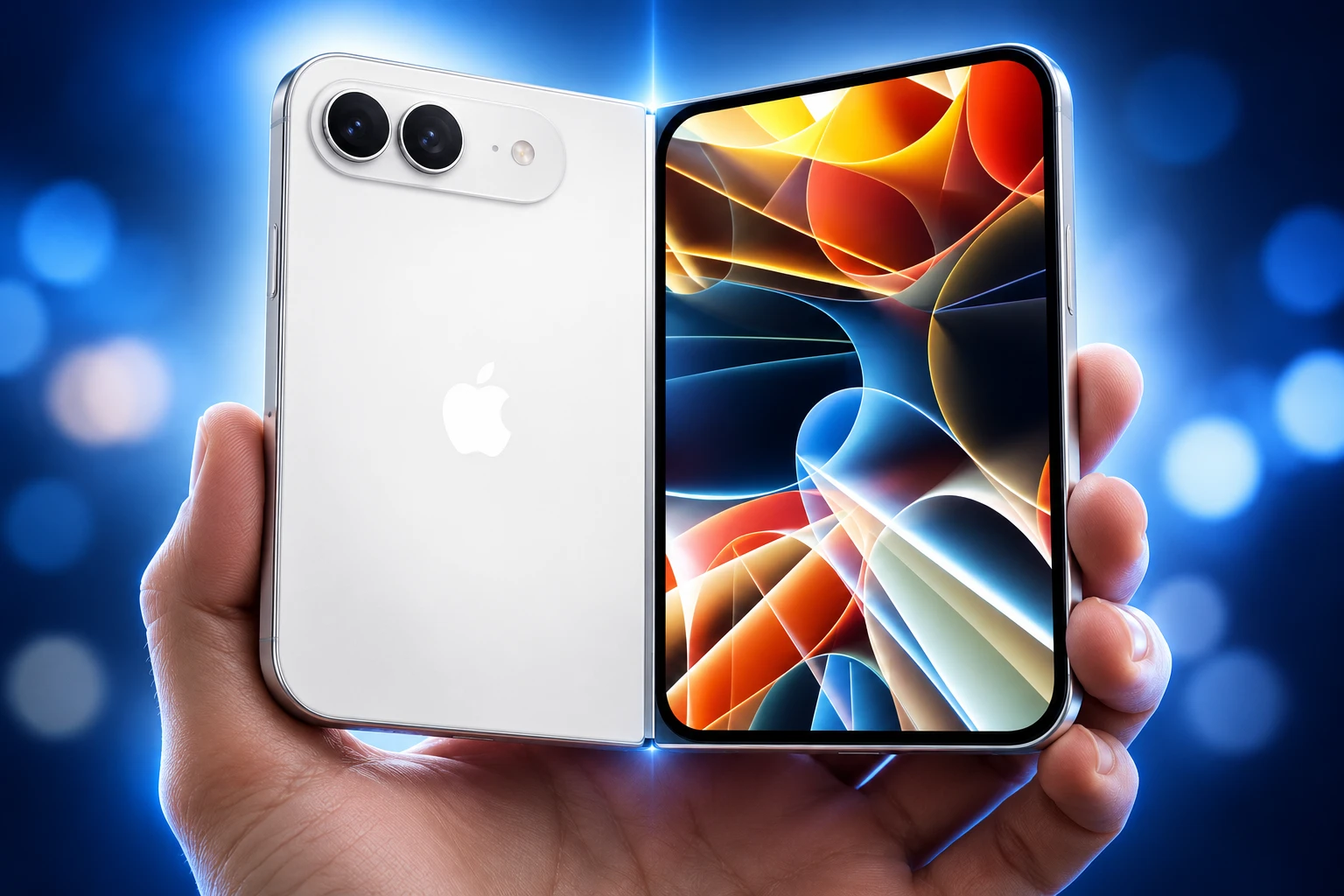
Apple is staging a book-style foldable iPhone at its Surprise and Shine event on September 9, with a starting price of $2,000. Hours before the stream, Apple reporter Mark Gurman said the company would show a $2,000-and-up foldable iPhone Duo, in white and dark blue, with 256 GB at the base and loaded storage climbing toward $3,000.
Samsung Display already holds a three-year exclusive on those foldable OLED panels. The hinge, not the screen, is the part that nearly slipped the September date.
A Passport When Closed, a Trackpad When Open
Gurman said designers compared the closed phone to a passport and the open phone to a Magic Trackpad. That is a short, wide book, closer to Samsung’s Galaxy Z Fold8 than to a tall clamshell Flip. TF International Securities analyst Ming-Chi Kuo puts the body at 9 to 9.5 mm folded and 4.5 to 4.8 mm unfolded, which would make the open phone Apple’s thinnest iPhone.
WHAT THE DUO IS EXPECTED TO CARRY
- The screens: A 5.5-inch cover panel and a 7.8-inch inner OLED, a hair under the 8.3-inch iPad mini.
- The chip: Apple’s A20 Pro processor and its second-generation C2 modem, with no physical SIM tray.
- The cameras: Two 48-megapixel rear lenses (wide and ultrawide) and a 12-megapixel front camera aimed at video calls.
- The extras: A magnetic hinge, side-button Touch ID instead of Face ID, and Apple Pencil support on the inner screen.
John Ternus is running the event as chief executive, eight days after he took the job on September 1. Gurman said Tim Cook stayed deep in the foldable program, and that Ternus was the executive who pushed it over the finish line. By late morning Pacific time on September 9, the Duo name was already on the stream as the foldable segment arrived.
Gurman also warned that the first unit may be less tough than a regular iPhone, with a weaker camera system and shorter battery life. That is the trade a first foldable usually makes. Apple is still asking Pro money for it.
Samsung Display Holds the Screen for Three Years
Industry sources in Seoul said on June 22 that Samsung Display had Apple’s sign-off to start foldable OLED module work in Vietnam after final yields cleared 80%, above Apple’s usual 70% bar. The first shipment for the year was put at 3 million panels. Samsung Display is the only company on both the cover screen and the inner fold, under a three-year deal that keeps other panel makers out.
Backend work, the step that adds driver chips, flexible boards, and protective layers, is running on part of Samsung Display’s Vietnam lines. Of about 80 backend lines at that plant, about 50 were already active, and a slice of those is now dedicated to Apple’s first foldable. The panel stack uses Color Filter on Encapsulation, which drops the polarizer, and Samsung Display’s M16 organic set, which the supplier has not put in a shipping phone before.
That is a strange kind of launch partner. Samsung still sells its own Fold line, including the Galaxy Z Fold8 that starts at $1,899, $101 under Apple’s expected base. Google’s Pixel 11 Fold Pro opens at the same $1,899. Apple’s first foldable is, for three years, a Samsung Display product with an Apple nameplate, which is why the “Apple copied Samsung” knock lands so fast. The clone charge is not only about the book shape. It is about who actually makes the glass that folds.
The Hinge Was the Part That Almost Missed the Date
The same June brief was blunt about what was still loose. Samsung Display’s side was clean. Apple’s hinge was not. Sources described a 3D-printed hinge module that made unwanted noise after assembly, with a hit to mass-build timing of two weeks to one month. “The launch schedule depends on Apple’s readiness with device components, especially the hinge,” one industry source said.
THE HINGE CALENDAR
- July 15, 2025: Kuo says Apple is taking Samsung Display’s crease-free stack rather than its own, with Fine M-Tec on the inner metal plates.
- October 13, 2025: Kuo pegs the finished hinge at $70 to $80, with a Foxconn joint venture with Shin Zu Shing taking about 65% of orders and Amphenol the rest.
- June 22, 2026: Industry sources say Samsung Display has Apple’s OK to run foldable OLED modules in Vietnam after yields topped 80%.
- June 2026: Those sources say the 3D-printed hinge is making noise after assembly, with a delay risk of two weeks to one month.
- July 5, 2026: Kuo puts third-quarter foldable assembly at 0.5 to 1 million units against 20 to 22 million iPhone 18 Pro and Pro Max units.
Kuo’s July survey is the inventory picture behind an October sale. He put second-half assembly at 7 to 8 million phones, and only 0.5 to 1 million units in the third quarter, about 10% of that half. The Pro models already had enough stock for a normal September launch. The foldable did not. He mapped it onto the iPhone X in 2017, which was announced on September 12, opened for pre-order on October 27, and went on sale on November 3 because the build had not filled the channel.
First-Year Supply Caps Out Near 6 Million
Counterpoint Research, in a September 7 note, still treats Apple’s first year as supply-capped. Associate Director Liz Lee put the upper end of 2026 shipments at 6 million even after the September 9 unveil, with sales spreading by market as the line ramps.
THE 2026 FOLDABLE SHARE FORECAST
| Brand | 2026 share | What the forecast assumes |
|---|---|---|
| Samsung | 38% | Still the volume leader, including the Galaxy Z Fold8 |
| Apple | 25% | Up to 6 million units in a short selling window |
| Huawei | 22% | Strong in China, third globally |
Those shares are Counterpoint’s August 2026 update, not Apple’s build plan. A 25% slice would still put Apple second in a category Samsung has owned since 2019, which is a loud debut on paper. It is not a second iPhone 18 Pro line. Kuo’s Pro assembly for the third quarter alone is 20 to 22 million phones.
Initial supply for Apple’s first foldable iPhone will inevitably be limited during the early production ramp, which keeps the upper end of our 2026 shipment forecast at 6 million units. Even with the short selling window, we still expect Apple to take 25% of the global foldable market and directly move into the No.2 position.
Liz Lee, Associate Director, Counterpoint Research
Counterpoint’s full-year cap of up to 6 million foldable iPhone shipments sits above the 3 million-panel first wave described in June, and below Kuo’s 7 to 8 million second-half assembly range. Those are different snapshots of different things, panels versus finished phones versus a half-year build, and they all point the same way: this is a scarce halo, not a volume iPhone. Counterpoint also said Apple’s share could reach 40% in 2027 once a full year of sales is on the books and shipments more than double.
Foldables Still Make Up 2% of Phones
The category Apple is entering is still small. Counterpoint puts foldables at about 2% of the overall smartphone market in the eighth year since the first commercial foldable in 2019, and it expects lifetime shipments to pass 100 million by the end of 2026. Research Director Tarun Pathak said there is room to grow, with Samsung still pushing new shapes, Huawei strong in China, and more brands preparing wider books.
THE FOLDABLE MARKET APPLE IS ENTERING
- 2025 volume: IDC counted 20.6 million foldable phones in 2025, up 10% from the year before.
- 2026 growth: IDC then raised its 2026 forecast to 30% year on year, from 6% in the prior outlook, citing Apple and Samsung’s Galaxy Z Trifold.
- Longer slope: IDC sees a 17% compound rate through 2029, against under 1% for ordinary smartphones, and foldables passing 10% of smartphone market value by 2029.
- Apple’s cut of the money: In December 2025, IDC’s Nabila Popal put Apple at more than 22% of units and 34% of foldable market value in year one, on a $2,400 average selling price.
Francisco Jeronimo, IDC’s vice president of client devices, said foldables will stay a niche in unit terms and a value driver because average prices run three times a standard smartphone. Counterpoint used the same 3x gap. That is the mix argument in one line, and it only works if Apple can actually deliver the scarce, expensive phone. A 6 million-unit cap against a 20-million-plus Pro quarter is not a mix shift. It is a showpiece with a waiting list.
What $2,000 Does Not Buy
The base Duo is $101 above the Galaxy Z Fold8 and the Pixel 11 Fold Pro. Gurman said Apple blew through its cost targets because of the memory shortage, discussed a $2,199 sticker, then ate some of that cost to hold the $2,000 start, while passing the rest through on higher storage. Sales were described as starting as early as October, after the iPhone 18 Pro models.
THE CUTS INSIDE A $2,000 PHONE
- No telephoto: Two rear cameras, wide and ultrawide, because the folded body has no room for a periscope module.
- No Face ID: A Touch ID side button, the same space-saving move Apple already uses on iPads.
- No September box: Gurman said the Duo goes on sale as early as October, not in the first Pro wave.
- Softer durability: Gurman said the first foldable may be less durable than a regular iPhone, with a weaker camera system and less battery life.
Apple Pencil support is the one feature Samsung walked away from. Samsung offered an S Pen on book Fold models from the Galaxy Z Fold3 through the Z Fold6, then dropped the stylus on the Z Fold7 to get the body thinner. If the Duo’s inner 7.8-inch panel takes a Pencil, Apple is selling a pocket iPad mini that Samsung no longer wants to be. That is also why a visible crease at this price is the failure people will not forgive. Spend $2,000 and watch a line appear across the inner screen six months later, and the Duo becomes a very expensive hinge demo.
Fine M-Tec Built the Plate That Hides the Crease
Kuo wrote in July 2025 that Apple chose Samsung Display’s crease-free solution over its own, and that the quiet winner is Fine M-Tec, which makes the inner display metal plates for the crease. The plate sits in the panel stack and spreads the stress of each fold so the OLED does not take a permanent set. He put Fine M-Tec’s share at 80% or more, with shipments of 13 to 15 million plates in 2026 at $30 to $35 each, a number that runs above finished-phone builds to cover yield loss and repair stock. The plates were due to start shipping in the first quarter of 2026, using laser-drilled microstructures to guide that stress.
Foxconn’s hinge joint venture with Shin Zu Shing, plus Amphenol’s remaining slice, is the other factory with skin in this phone. Kuo’s $70 to $80 hinge cost is the cheap version of a part that still made noise in June. Liquid metal, supplied in some accounts by Dongguan EonTec, is the material Apple wanted in the hinge so it would flex without taking a set. Module assembly, not the metal itself, was the bottleneck.
None of that shows up in a mix model. The Duo Apple is showing on September 9 is a $2,000 passport that opens like a trackpad, with a Samsung Display exclusive on the glass, a Fine M-Tec plate under the fold, and a hinge that ate the calendar. Gurman said it goes on sale as early as October. If Kuo’s third-quarter build is right, the first wave will sell out, lead times will stretch, and the honest test of demand will not land until late 2026 or the first quarter of 2027, after the launch noise fades and the line can actually fill orders.

Lerwick’s Late Dredge Is Built for Heavier Energy Ships

Skydance Closes the Warner Deal Under $80 Billion Debt

Modern Warfare 4 Hides Enemy Data to Starve Wallhacks

Apple Watch Series 12 Ships Whoop-Style Scores Without the Band

SteelSeries Arctis GameBuds Return as a $199 Color Drop

How to Dress for an Interview Men – The Dos and Don’ts of Professional Attire

Cleveland Bets on Classroom AI as New York Hits Pause

HP Wraps NVIDIA’s Chip in OmniBooks After a Share Rally

Miami-Dade Sent Rockstar a Vice City Wish List

How Much Do Gymshark Athletes Make – The Income and Sponsorship of the Popular Fitness Brand Ambassadors
-
 BUSINESS3 years ago
How to Dress for an Interview Men – The Dos and Don’ts of Professional Attire
-
 NEWS1 month ago
Cleveland Bets on Classroom AI as New York Hits Pause
-
 BUSINESS1 month ago
HP Wraps NVIDIA’s Chip in OmniBooks After a Share Rally
-
 GAMING1 month ago
Miami-Dade Sent Rockstar a Vice City Wish List
-

 NEWS1 month ago
Pinterest Turns a Shopping Guide Into a Q4 On-Ramp
-

 BUSINESS1 month ago
Canada’s Matched Tariffs Expose a Supply Chain It Shares
-

 NEWS1 month ago
Australia Offers a Feed Switch and a Duty on Chatbots
-
 BUSINESS2 years ago
How Much Do Gymshark Athletes Make – The Income and Sponsorship of the Popular Fitness Brand Ambassadors